 Stack

Help Scout
The only help desk on this desk that caps users on three of its four tiers, and the only one that prices extra inboxes on the card
Scored on the published rubric, from documentation, pricing and verified user reports.
Best for: Support teams of five to twenty-five people who want a free tier that actually seats five, and who can live without single sign-on or a published monthly rate.
Verdict
Help Scout publishes more seat arithmetic on the card than most help desks and less billing arithmetic than any of them. This is a documentation review built from the pricing page as displayed on October 25, 2026, not from direct use.
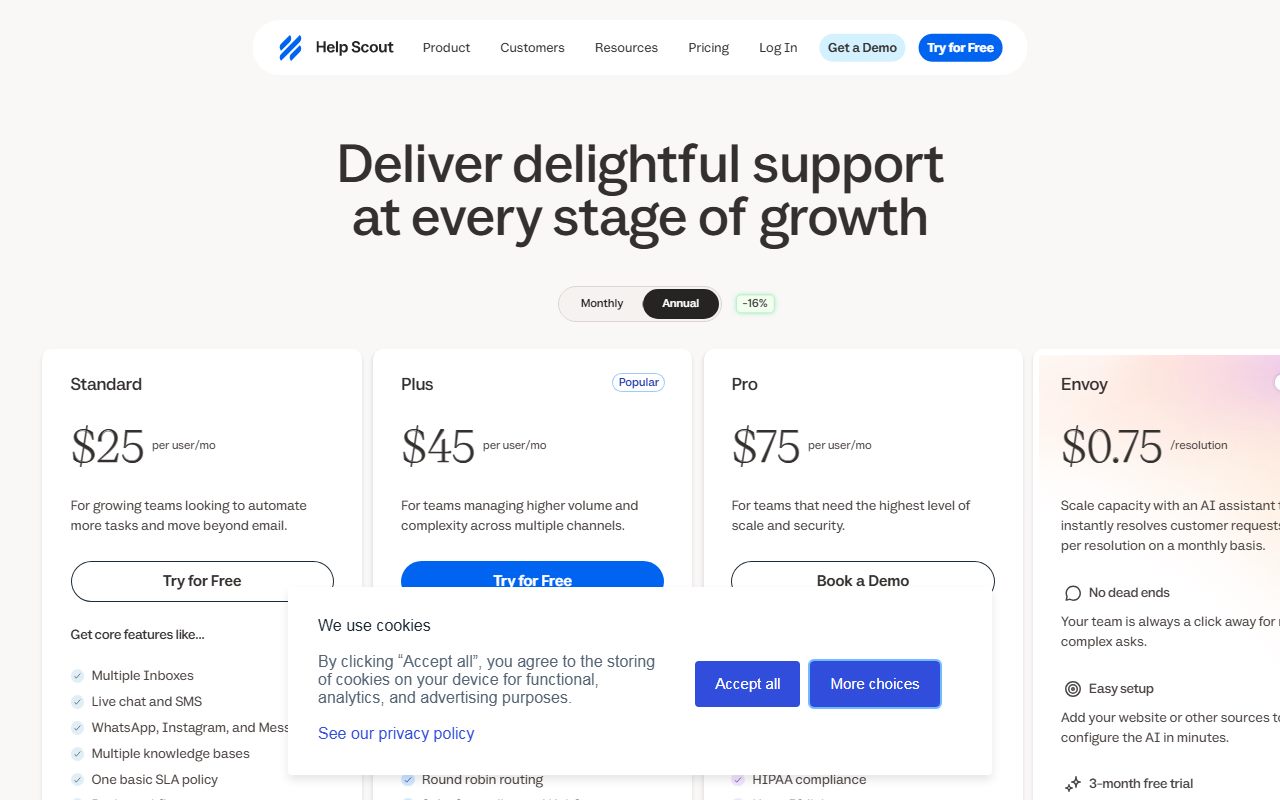
Four tiers are listed: Free at $0, Standard at $25 per user per month, Plus at $45 and Pro at $75.
All three paid rates sit behind an Annual toggle carrying a -16% badge, and the monthly equivalents are not in the markup on either read. The Users row is where this page earns its grade.
It reads Up to 5, Up to 25, Up to 50 and Unlimited (minimum 10), so headcount picks the tier before features do. That minimum makes Pro a $750 a month purchase at its floor, by our arithmetic.
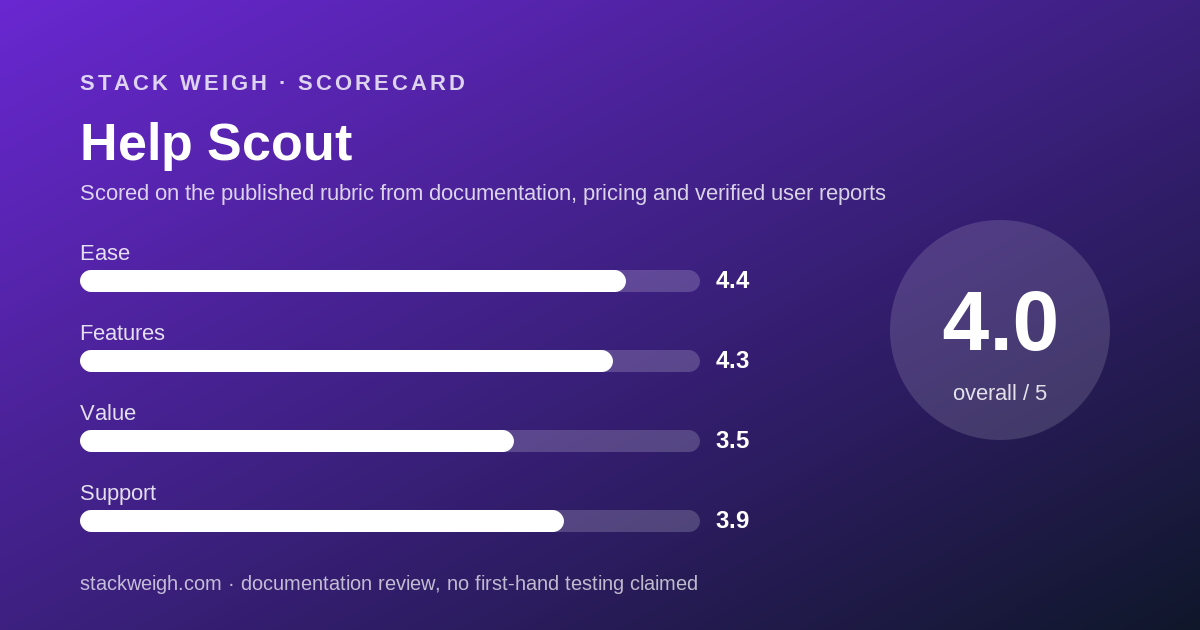
Ease scores 4.4 because seat caps, the seat floor, add-on inbox prices and per-minute API limits are all printed. Value scores 3.5 because the monthly rate is missing and single sign-on is an add-on on two of three paid tiers.
Visit Help Scout
We have no affiliate relationship with this vendor. Link goes to the official site.
Where it is strong
- The Users row prints a number for every tier: Up to 5, Up to 25, Up to 50 and Unlimited (minimum 10)
- The free tier seats five people, not one, and includes email, contact forms, a Docs site and auto reply
- Add-on prices are on the comparison table rather than in a quote: extra inboxes $10 a month, extra Docs sites $20 a month
- The same page carries both an annual and a monthly rate for those add-ons, at $10 against $12 and $20 against $24
- API rate limits are published per tier at 200, 400 and 800 calls a minute
- The three paid prices also appear in the page's JSON-LD offer list, which matched the rendered cards on both reads
Where it falls short
- No monthly per-seat rate appears anywhere in the markup, only a -16% badge next to the Annual toggle
- Pro states a minimum of 10 users at $75 each, which is $750 a month before any add-on by our arithmetic
- Single sign-on reads Add-on on both Standard and Plus, and is only included on Pro
- HIPAA compliance reads Add-on on Plus and is absent from Standard, with no price given for either add-on
- The page contradicts itself on light users: the Pro card says Up to 50 light users while the comparison table says 15 included
- Standard caps at 25 users and Plus at 50, so growth forces a tier change rather than just a bigger invoice
At a glance
| Starting price | $0 on Free. First paid tier is Standard at $25 per user per month with the Annual toggle selected |
|---|---|
| Pricing note | From $25 per user per month on Standard with the Annual toggle selected, against $45 on Plus and $75 on Pro, whose Users row reads Unlimited (minimum 10) (pricing page, checked October 25, 2026) |
| Monthly-billing price | Not present in the markup on either read of October 25, 2026. A Monthly button exists and an annual badge reads -16% |
| Free plan | Yes, listed at $0 in both the card and the JSON-LD offer list, with Up to 5 users |
| Seat minimum | None stated on Free, Standard or Plus. Pro's Users row reads Unlimited (minimum 10) |
| Seat maximum | Up to 5 on Free, Up to 25 on Standard, Up to 50 on Plus, Unlimited on Pro |
| Included inboxes | 1 on Free, 2 on Standard, 5 on Plus, 10 on Pro, with additional inboxes at $10 a month |
| Included knowledge bases | 1 Docs site on Free, 2 on Standard, 3 on Plus, 5 on Pro, with additional sites at $20 a month |
| Trial | 15 days on Standard or Plus with no credit card required. A Pro trial routes to the sales team |
| AI chatbot add-on | Envoy, $0.75 per resolution on Standard, Plus and Pro, with a monthly spending cap the buyer sets |
| API limits | 200 calls a minute on Standard, 400 on Plus, 800 on Pro. Not listed on Free |
What Help Scout actually sells
Help Scout sells a shared inbox, a knowledge base and a chat widget, priced per user with a hard cap on users at every paid tier but one.
The pricing page publishes four tiers: Free at $0, Standard at $25 per user per month, Plus at $45 and Pro at $75.
Those three paid figures appear with the Annual toggle selected and a -16% badge beside it. They also appear in the page's JSON-LD offer list as prices of 25, 45 and 75 for one user per month.
What makes this price list unusual is the cap. The comparison table's Users row reads Up to 5, Up to 25, Up to 50 and Unlimited (minimum 10) across the four tiers.
So the tier is decided by headcount before it is decided by features. Our guide to reading a per-seat pricing page explains why that ordering matters.
Who Help Scout is best for
The shape of this price list rewards small teams that stay small and punishes teams that cross a ceiling mid-term.
- A support team of six to twenty-five people, which is the whole of Standard's band at $25 a user
- A team of five or fewer that can live inside 1 inbox and 100 contacts a month, because Free seats five
- A company that buys help centres rather than headcount, since extra Docs sites are priced at $20 a month
- A buyer who wants published API rate limits, listed at 200, 400 and 800 calls a minute by tier
- A team that needs WhatsApp, Instagram and Messenger on the cheapest paid tier, where all three are included
- Anyone comparing a help desk against a chat tool instead, which our team chat and video price guide covers
Who should skip it
Three buyers should look elsewhere first.
- Teams that must have a monthly-billing figure in writing before signing anything
- Teams of more than fifty agents, where only the $75 tier remains and it has a 10-seat floor
- Regulated buyers who need HIPAA coverage priced, since the page marks it Add-on on Plus without a rate
What the free tier includes, as of October 2026
Free is a real plan rather than a trial, and it is the most generous $0 help desk tier on this desk by seat count.
The comparison table gives Free Up to 5 users, 1 inbox, 1 Docs site, 100 contacts a month, 10 saved replies, 10 tags and 10 articles.
It also includes email, contact forms, help articles, auto reply, snooze, send later and customer profiles with history.
What Free does not have is the rest of the product. Live chat, Messenger, Instagram, WhatsApp, surveys, custom reports and exports all read as not included on that tier.
Integrations are throttled rather than removed: the Access to 100+ apps row reads Limit to 1 on Free. Report history is 30 days against 2 years on Standard.
How the pricing is structured
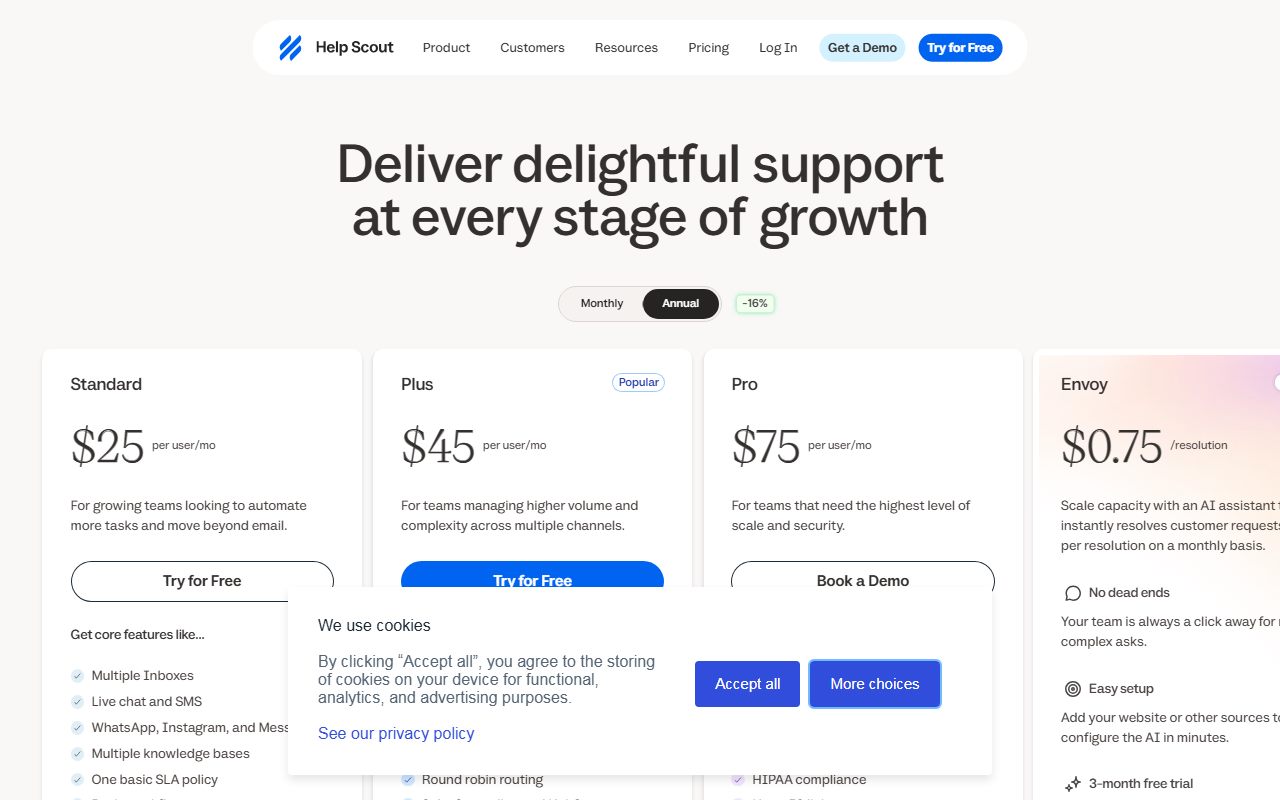
This is a per-seat ladder with three ceilings and one floor, and the ceilings do more work than the rates.
Standard at $25 buys 2 inboxes, 2 Docs sites, 1 basic service-level policy, 150 basic workflows, unlimited AI Assist and a 2-year report history.
Plus at $45 buys 5 inboxes, 3 Docs sites, 2 advanced policies, 500 advanced workflows, round-robin routing, unlimited AI Drafts and the Salesforce, HubSpot, Jira and Linear integrations.
Pro at $75 buys 10 inboxes, 5 Docs sites, unlimited policies, unlimited advanced workflows, load-balanced routing, included single sign-on, included HIPAA compliance and included IP restrictions.
The Pro card adds a dedicated onboarding specialist, a strategic account manager and preferred pricing on Aircall. None of those three carry a figure.
The Pro plan has a ten-seat floor, and that is the real entry price
Pro is the only tier here with no user ceiling, and it is also the only one with a stated minimum.
Its Users row reads Unlimited (minimum 10). At $75 per user per month that is $750 a month, or $9,000 a year, by our arithmetic.
That figure matters because Pro is where single sign-on, HIPAA compliance and IP restrictions stop being add-ons and start being included.
So a six-person team with an identity-provider requirement is not buying six seats at $75. It is buying ten.
Seat floors are the most expensive line in small-team software and the least visible. The same pattern runs through our password manager seat-count guide.
What the twelve-month bill looks like at four headcounts
The figures below are editorial arithmetic from the displayed annual-billing rates, over twelve months, excluding tax and add-ons.
Where a tier's user ceiling rules out a headcount, we say so rather than extrapolating a price the page does not offer.
- 1 agent: Free $0. Standard $300. Plus $540. Pro unavailable, because the stated minimum is 10 users
- 5 agents: Free $0 and at its ceiling. Standard $1,500. Plus $2,700. Pro still unavailable below its floor
- 10 agents: Standard $3,000. Plus $5,400. Pro $9,000, which is exactly its minimum
- 20 agents: Standard $6,000. Plus $10,800. Pro $18,000
- 50 agents: Standard unavailable above 25 users. Plus $27,000 and at its ceiling. Pro $45,000
- The free tier is worth $1,500 a year against Standard at its own ceiling of five people
The page disagrees with itself on light users
One row on this pricing page contradicts the card above it, and the gap is large enough to change a purchase.
The Pro plan card lists Up to 50 light users as a bullet. The comparison table's Light users row gives Pro 15 included.
Light users are the read-only collaborators who comment on tickets without handling them, so the difference between 15 and 50 is a real staffing question.
Both strings were present on both reads of October 25, 2026, so this is not a rendering artefact. We print both and recommend confirming the number at checkout.
The same table gives Plus 5 included light users and marks the row as not included on Free and Standard.
What sits behind an add-on rather than behind a tier
Help Scout uses the word Add-on in its comparison table more often than most vendors, and never with a price next to it.
Single sign-on reads Add-on on Standard and Plus, included on Pro, and not included on Free. IP restrictions follow the same pattern exactly.
HIPAA compliance reads Add-on on Plus, included on Pro, and not included on the two cheaper tiers. Aircall reads Add-on on Standard and Plus, and Preferred pricing on Pro.
None of those four add-ons carries a figure anywhere in the markup we read.
The one add-on that is priced is the AI chatbot, Envoy, at $0.75 per resolution on all three paid tiers. The FAQ confirms a monthly spending cap can be set, after which AI Answers switches off.
Ease of use: what the 4.4 is built from
The grade is for the price list, not the product. On that measure this page is above average for the category.
It publishes a seat ceiling for three tiers and a seat floor for the fourth. Most per-seat pages publish neither.
It prices its two commonest overages on the card, at $10 a month for an extra inbox and $20 for an extra Docs site, with the monthly alternatives of $12 and $24 in the FAQ.
It also carries machine-readable offers, so the rendered cards and the structured data can be checked against each other. Ours matched.
The 0.6 we withheld is for the missing monthly seat rate and the four unpriced add-ons.
Value: what the 3.5 is built from
At five seats and under, this is the best-value help desk on the desk, because the free tier is the only one that seats a team.
Between six and twenty-five it is mid-market: $25 a seat is more than two rivals charge for their entry tier.
Above twenty-five the value falls away. Plus at $45 is an 80 percent increase on Standard, by our arithmetic, for capacity rather than a new category of feature.
The $75 Pro tier with a ten-seat floor is the most expensive published entry point in this comparison.
For a sense of how other categories price the same growth curve, see our team wiki price guide.
Support: published channels and limits
The comparison table's Email support row reads Standard on the Standard tier and Priority on Plus and Pro.
No phone number, no stated response time and no support hours appear on the pricing page as read on October 25, 2026.
Pro adds a dedicated onboarding specialist and a strategic account manager as card bullets. Neither is defined further and neither has a price.
The page does publish an escalating API allowance, which is a kind of support commitment: 200 calls a minute on Standard, 400 on Plus, 800 on Pro.
Our 3.9 reflects published priority tiers without published response times.
What we could not read, and what we are not claiming
One figure on this page did not survive verification, and we would rather print the gap than a guess.
The monthly per-seat rate is not in the markup. A Monthly button exists next to the Annual button, and a badge reads -16%, but no monthly number renders.
We read the page twice on October 25, 2026, through a headless browser and a direct fetch, and requested it again with a monthly billing parameter. All three reads returned the same three annual figures.
We are not saying Help Scout does not publish a monthly rate. We are saying it was not readable on this URL on that date, so we have not printed one.
For the method behind that rule, see how to turn a pricing page into a bill.
Alternatives
Help desks are not the only tools a support team buys per seat, and the seat-cap pattern here shows up elsewhere on this site.
Choose a collaboration suite instead if tickets are only part of the job: Slack and Google Workspace are both priced per seat with their own ceilings, compared in Slack vs Google Workspace.
Choose a document platform instead if most inbound work arrives as files: Box prices storage and users together.
Otherwise choose Help Scout if your team is five people or fewer, or if it sits inside Standard's 25-user ceiling and you want inbox and help-centre overages priced in advance.
If the real question is which unit you are being billed in, read comparing quotes priced in different units.
Bottom line
Help Scout publishes the seat arithmetic its rivals hide and hides the billing arithmetic its rivals publish.
Every tier has a seat number on it, which is rare and genuinely useful. Pro's ten-seat floor is stated rather than discovered at checkout.
Against that, there is no monthly seat rate to read, four add-ons have no price, and the page disagrees with itself about how many light users Pro includes.
At five seats or fewer the free tier is the best value in this category. Between six and twenty-five, Standard at $25 is defensible but not cheap.
Above twenty-five seats, price the alternatives before renewing.
Buy it if
- Your support team is between six and twenty-five people, which is the band Standard is capped for at $25 per user per month
- You want a free tier that seats a real team, since Free is the only $0 plan on this desk with an Up to 5 users row
- You add inboxes or help centres more often than people, because both are priced on the card at $10 and $20 a month
- You can treat single sign-on as a later purchase, since it reads Add-on until Pro
Skip it if
- You need a monthly-billing figure before you sign, because no monthly per-seat rate is in the markup on this page
- Single sign-on is a day-one requirement, which puts the cheapest included route at $75 per user per month with a 10-user floor
- You expect to pass fifty support agents, because only the $75 tier has no user ceiling
Frequently asked
How much does Help Scout cost for a 10-person team?
$3,000 a year on Standard, from $25 per user per month read on October 25, 2026, by our arithmetic. Plus is $5,400 and Pro is $9,000 for the same ten people. Ten is also the exact minimum Pro states.
Does Help Scout have a free plan?
Yes. Free is listed at $0 on the card and as a price of 0 in the page's JSON-LD offer list. Its Users row reads Up to 5, with 1 inbox, 1 Docs site, 100 contacts a month and 30-day report history.
What is the cheapest Help Scout plan with single sign-on?
Pro at $75 per user per month, where the SSO/SAML row is included rather than an add-on. On Standard and Plus the same row reads Add-on, and the page gives no price for that add-on as read on October 25, 2026.
Is Help Scout cheaper billed monthly or annually?
Annually, but the size of the gap is only published for add-ons. Extra inboxes are $10 a month paid annually against $12 monthly, and extra Docs sites $20 against $24. The seat rates carry a -16% badge with no monthly figure shown.
What happens when a Standard team passes 25 people?
The tier runs out. Standard's Users row reads Up to 25, so the next published step is Plus at $45 per user per month. For 26 people that moves a $7,500 annual bill to $14,040 by our arithmetic.
How long is the Help Scout trial?
15 days on Standard or Plus, with the page stating no credit card required. A Pro trial is not self-serve: the pricing FAQ directs buyers who want one to talk to the sales team.
Sources
- Help Scout pricing page, plan cards and comparison table - checked October 25, 2026
- Help Scout pricing page, JSON-LD offer list (Free 0, Standard 25, Plus 45, Pro 75) - checked October 25, 2026
Update history
- October 25, 2026 - First publication. Prices read from the pricing page through a headless browser and a direct fetch on the same date, with the JSON-LD offer list used as a third check.
Visit Help Scout
We have no affiliate relationship with this vendor. Link goes to the official site.