 Stack
StackSlack vs Google Workspace: which costs less for a team
Slack Pro is $7.25 per seat per month billed annually. Google Workspace Business Starter is $7.00 on a one-year commitment and includes chat, video, mail and storage. The 25-cent gap is not the story; the story is what each seat buys and what each contract lets you undo. This is a documentation comparison from both pricing pages as read on October 10, 2026, priced at 1, 5, 10, 20 and 50 seats.
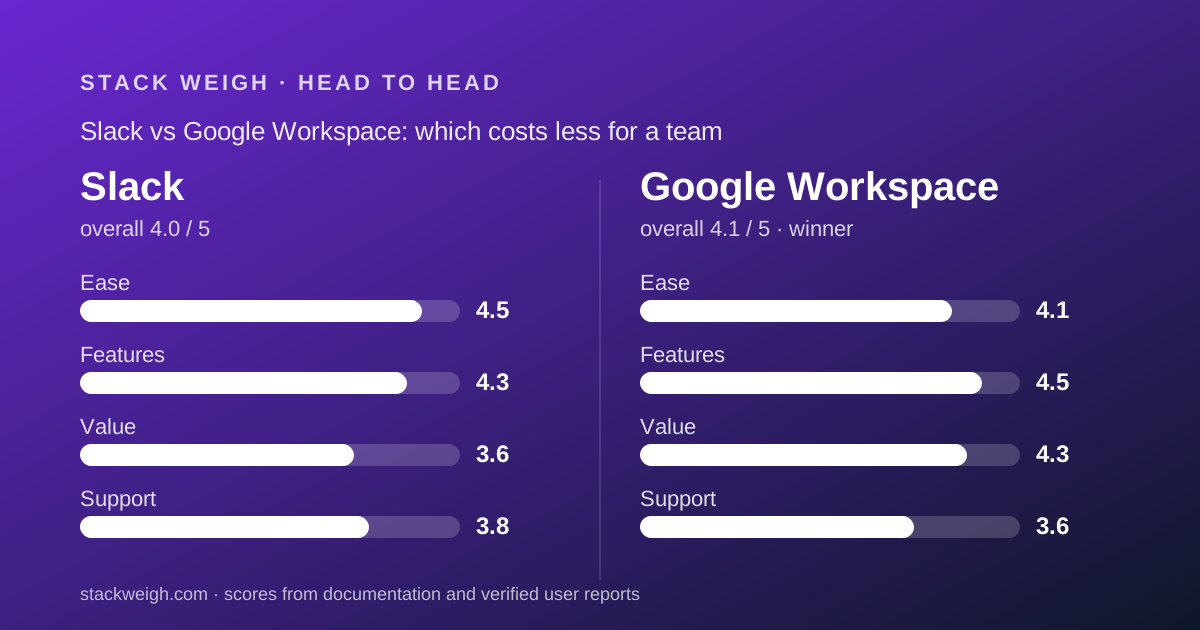
 4.0Slack
 4.1Google Workspace
The short answer
Google Workspace wins on cost for most teams, because its cheapest seat includes the chat and video a Slack seat charges for separately, plus mail and storage. Slack wins where chat is the product and contract flexibility matters more than the bundle.
- Slack is best for teams whose work happens in chat, who already pay for mail elsewhere, and whose headcount moves month to month
- Google Workspace is best for teams that need mail, chat, video and storage on one bill and can commit to seat count for a year
- Winner on 12-month cost for a 10-person team: Google Workspace Business Starter at $840 against Slack Pro at $870, by our arithmetic, and the Workspace seat covers three more functions
Documentation disclaimer
Everything here comes from the [Slack pricing page](https://slack.com/pricing), the [Google Workspace pricing page](https://workspace.google.com/pricing) and the Workspace admin knowledge base, all read on October 10, 2026. We have not run a test workspace on either product for this piece. Where a page does not publish a figure, the table says so rather than guessing. The individual Slack review and Google Workspace review hold the full tier breakdowns.
Pricing: Google Workspace costs less at every headcount on list price
The entry tiers are 25 cents apart per seat and the mid tiers are a dollar apart, so on list price alone the two are close. Over 12 months the gap is small in dollars and large in what the dollars buy.
By our arithmetic, on annual billing, Slack Pro costs $87 for 1 seat, $435 for 5, $870 for 10, $1,740 for 20 and $4,350 for 50. Google Workspace Business Starter on commitment costs $84, $420, $840, $1,680 and $4,200 at the same headcounts.
At the mid tier, Slack Business+ at $15 runs $180, $900, $1,800, $3,600 and $9,000. Workspace Business Standard at $14.00 runs $168, $840, $1,680, $3,360 and $8,400.
On monthly billing the ordering holds: Slack Pro at $8.75 is $1,050 for 10 seats; Workspace Starter on Flexible at $8.40 is $1,008.
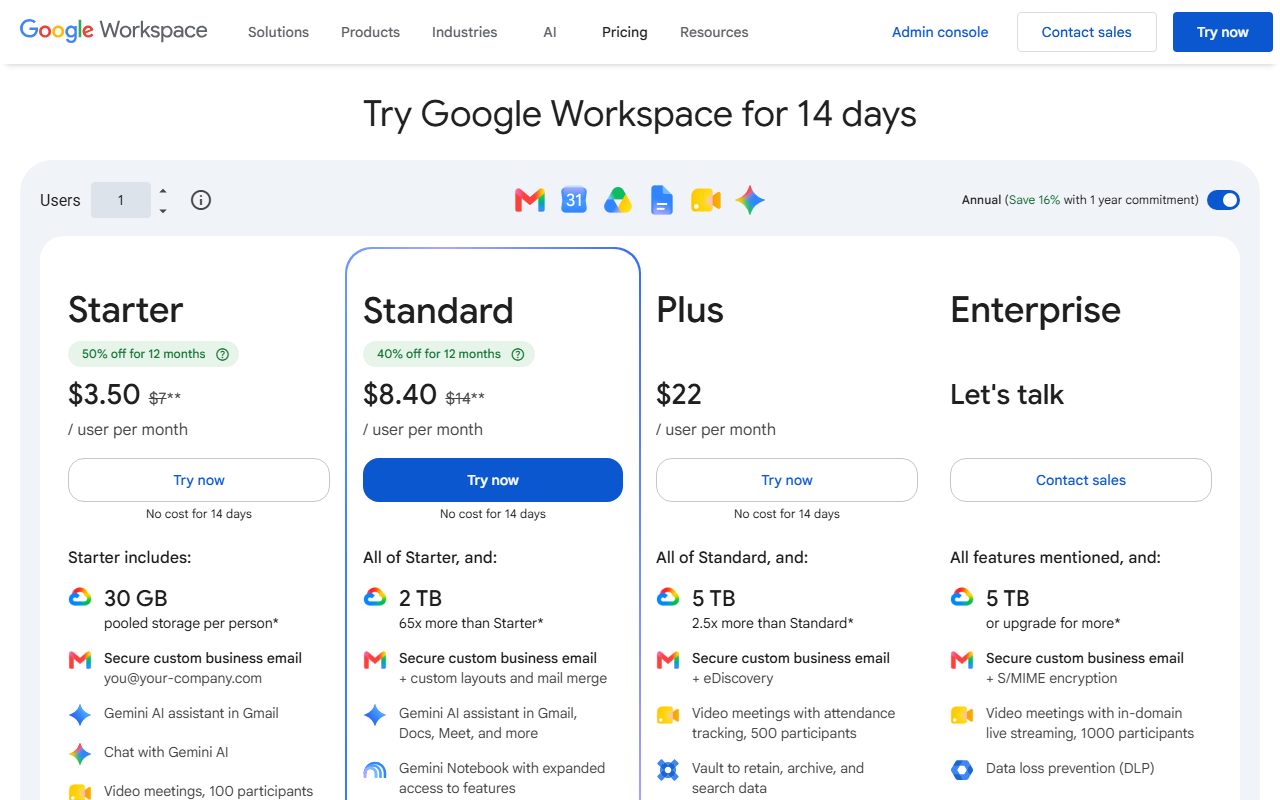
The promotions change year one for qualifying teams. Slack's 50% applies for 3 months on monthly billing only, which the Slack review works out to roughly $919 for 10 seats. Google's intro rate of $3.50 on Starter for 12 months, first 20 users, new customers only, puts a 10-person team at $420 for year one. That is less than half of Slack's best case, but it expires.
What the seat buys: Workspace bundles four functions, Slack sells one
A Slack Pro seat buys unlimited message history, unlimited app integrations, group huddles, external messaging with up to 250 organisations, basic AI, SAML SSO, SCIM and native DLP. Nothing else. No mailbox, no storage quota, no published meeting participant cap.
A Workspace Business Starter seat buys Gmail on your domain, Google Chat, Google Meet with 100 participants for 24 hours, 30 GB pooled storage, Gemini in Gmail and fundamental endpoint management. It does not include Meet recording, noise cancellation or Gemini in Docs, Sheets and Meet; those start at Standard.
The comparison most teams actually face is therefore not Slack Pro versus Workspace Starter. It is Slack Pro plus whatever they already pay for mail, versus Workspace Starter alone. For a team already on Workspace for Gmail, adding Slack Pro is a second $7.25 per seat for a chat layer the bundle already includes in some form.
For a team on Microsoft 365, the arithmetic flips: Workspace would duplicate mail and storage, and Slack Pro is the cleaner addition. Our guide to comparing quotes in different units covers how to line up a single-function seat against a bundle.
Contract terms: Slack is easier to leave; Workspace is cheaper if you stay
This is where the 25-cent price gap stops mattering. The two vendors treat a shrinking team very differently.
Slack's pricing page describes fair billing: active members are those who act within a 28-day window, inactive paid members receive a prorated credit, and new members are charged pro rata. A 10-seat team that drops to 8 active people pays, in effect, for 8. Annual billing is available but the page does not describe a penalty for reducing seats.
Google's knowledge base is explicit the other way. On the Annual plan you must pay the full commitment even if you cancel early, no refunds are issued, and licences can only be reduced at renewal. A 10-seat team that drops to 8 in month three pays for 10 until month twelve.
The Flexible plan removes that risk at $8.40 per seat, 20% above commitment by our arithmetic. At 10 seats that is $1,008 a year, which is $138 more than Slack Pro on annual. So the honest comparison for a team that cannot promise its headcount is Slack Pro at $870 against Workspace Flexible at $1,008, and Slack is cheaper.
For a team that can commit, Workspace at $840 is cheaper and buys more. The contract question decides the winner more than the list price does. Our per-seat pricing guide treats this as the third multiplication most buyers skip.
Chat: Slack publishes more about its chat tier; Workspace publishes more about everything else
On the pricing pages, Slack's chat feature list is specific: history limits, integration counts, external messaging scope, huddle types, SSO and DLP by tier. A buyer can map a requirement to a tier without leaving the page.
Google Chat's rows on the Workspace page are thin by comparison: history on or off by default and auto-accept of invitations, listed on every tier. The page does not state integration counts, external messaging limits or anything resembling Slack's tier gates for chat.
That is not evidence that Google Chat lacks those capabilities; it is evidence that the pricing page does not sell on them. For a documentation comparison it means Slack's chat tier is easier to price against a requirement, and Workspace's chat is a line item you accept as part of the bundle.
If the team's requirement list for chat is long, Slack's page will answer it and Workspace's will not. If the requirement is a place to message colleagues that comes with the mail, Workspace's page is sufficient.
Video: Workspace states its limits; Slack does not publish a huddle cap
Google Meet's limits are printed: 100 participants on Starter, 150 on Standard, 500 on Plus, 1,000 on Enterprise, 24 hours on all, recording to Drive from Standard, noise cancellation from Standard, attendance tracking from Plus.
Slack's page says huddles are 1:1 on Free and group on Pro and above. It does not state a participant cap, a duration limit or whether huddles can be recorded. For a team whose video needs are specific, that silence is a cost: the figure has to come from the help centre or a sales conversation.
A 10-person team that holds internal calls and occasional client meetings under 100 people is covered by Workspace Starter on the published numbers. The same team on Slack Pro has group huddles and no documented ceiling. Teams that need recordings are at Workspace Standard, $14.00, or looking at a separate video product such as Zoom Workplace.
Mail and storage: Workspace includes them; Slack assumes you have them
This is the structural reason Workspace wins on cost. Business Starter includes Gmail and 30 GB of pooled storage per user; Standard raises storage to 2 TB. Slack includes neither, and its pricing page does not state a file storage figure for any plan.
For a team that must buy mail somewhere, Slack's real seat cost is $7.25 plus the mail seat. For a team that already has mail from Microsoft, the Workspace bundle is partly redundant and its advantage shrinks to the price of Chat and Meet alone, which Google does not sell separately.
So the winner depends on a question neither pricing page asks: who provides your email today?
AI: both bundle it by tier; neither lists a separate AI price
Slack includes basic AI on Pro and advanced AI, including Slackbot, AI search, daily recaps and AI workflow generation, on Business+ at $15. No AI add-on price is listed; Business+ customers on invoice can buy Flex Credits through Salesforce at an unpublished price.
Workspace includes Gemini in Gmail and Vids on Starter, with the Gemini app at basic access and Gemini Notebook at 3 Audio Overviews per day. Standard extends Gemini to Docs, Sheets, Slides, Drive, Meet and Chat and raises Notebook to 20 per day. An AI Expanded Access add-on is listed as sold separately with no price.
In both cases the useful AI sits one tier above entry, and in both cases that tier roughly doubles the seat price. Neither page lets a buyer price AI alone.
Support: Slack publishes a 24/7 tier; Workspace is quiet below Enterprise
Slack places 24/7 support at Business+ and a 24/7 priority tier with a 4-hour first response at Enterprise+. It does not define support on Free or Pro.
Workspace's pricing page names Enhanced Support only on Enterprise and mentions paid upgrades to Enhanced or Premium. It does not describe what Starter, Standard or Plus customers receive.
For a 10-person team at the entry tier, neither page commits to a response time. Slack at least shows a published path to one at $15 per seat. Workspace's path is a paid support upgrade whose price is not on the page.
What users report
We have not yet compiled dated samples of G2, Capterra or Reddit reports for either product, and this comparison does not summarise impressions we have not collected. When those samples exist, both reviews and this page will be updated with sourced, dated findings. Until then the comparison rests on what the vendors publish.
Choose Slack if
Four conditions point to Slack.
- Chat is the product you are buying and the team expects to live in it, with integrations as the deciding feature
- You already pay for mail and storage from Microsoft or another provider and do not want a second bundle
- Headcount moves month to month, because fair billing credits inactive seats and the page describes no lock-in penalty
- You need SAML SSO and SCIM at the entry paid tier, which Slack Pro includes at $7.25
Choose Google Workspace if
Four conditions point to Workspace.
- You need business email on your domain anyway, which makes Chat and Meet effectively free inside the $7.00 seat
- Meetings stay under 100 people and nobody needs recordings, which Starter covers on the published limits
- Headcount is stable for 12 months, so the commitment price is safe and the Flexible premium is avoidable
- You are a new customer with 20 or fewer users and the intro rate of $3.50 on Starter applies, cutting a 10-person team's year one to $420
Frequently asked
Short answers to the questions people type into a search box.
Bottom line
On the published numbers Google Workspace Business Starter is the cheaper seat and the bigger bundle: $840 a year for 10 people against $870 for Slack Pro, with mail, storage and 100-person Meet inside. That makes it the winner for a team that needs email and can commit for a year.
Slack wins the narrower case: chat as the product, mail already paid for, headcount that cannot be promised. In that case Slack Pro at $870 beats Workspace Flexible at $1,008.
Teams that need video beyond Workspace Standard's 150 participants or Slack's unpublished huddle limits should read the cheapest chat-and-video stack for a 10-person team, which adds Zoom Workplace to the arithmetic. All figures checked October 10, 2026.
Visit Slack
We have no affiliate relationship with this vendor. Link goes to the official site.
Visit Google Workspace
We have no affiliate relationship with this vendor. Link goes to the official site.