 Stack
The cheapest project management plan at every size
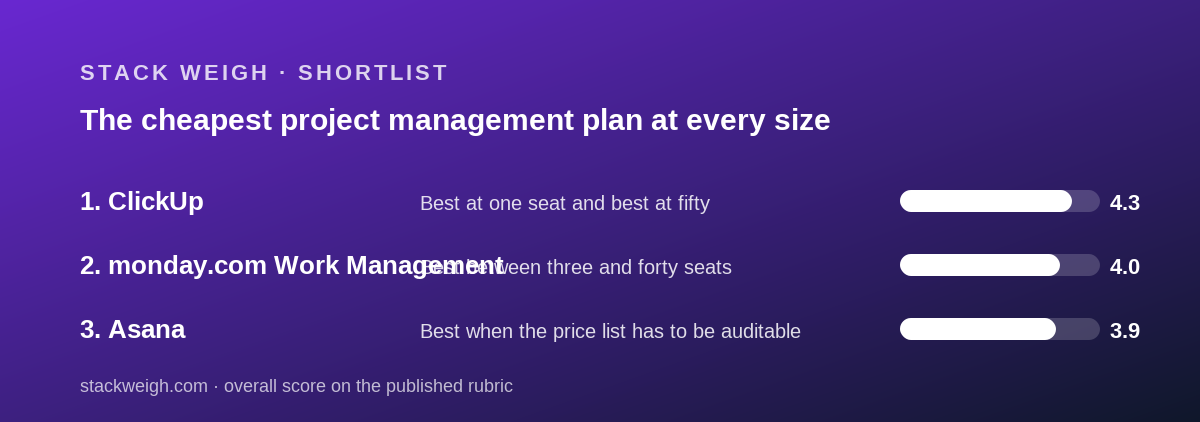
The cheapest project management seat is US$9 a month billed annually, and two vendors charge it. Which one is actually cheaper depends entirely on how many people you are buying for. At one seat the answer is ClickUp at US$108 a year, because it is the only one of the three that will sell a single licence. At five and twenty seats monday.com ties it to the cent, then wins outright if most of your people only need to watch. At fifty seats monday.com stops publishing a price at all, which leaves ClickUp against Asana at a difference of US$1,194 a year. Every figure here was read from the vendor's own pricing page on October 29, 2026. The totals are our arithmetic, and we show the multiplication each time.
Our picks
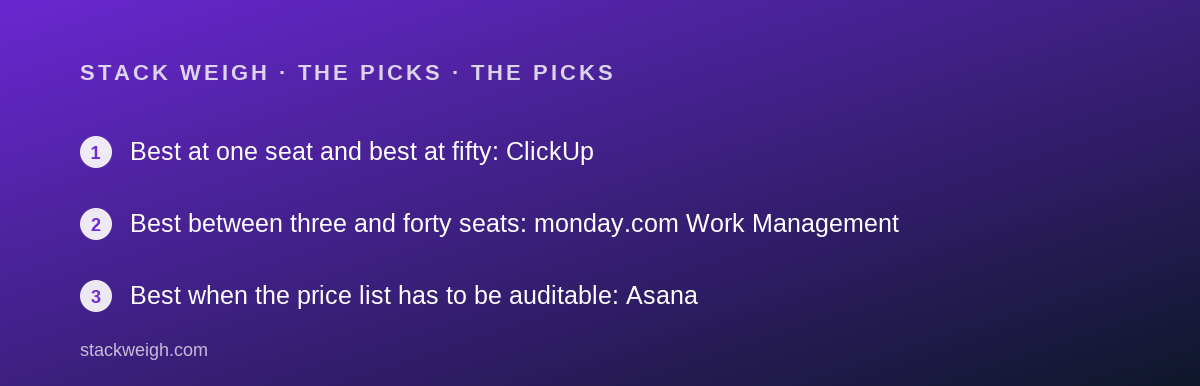
- Best at one seat and best at fifty: ClickUp
- Best between three and forty seats: monday.com Work Management
- Best when the price list has to be auditable: Asana
The answer at four headcounts
Entry tier, billed annually, before tax. Each figure is the published monthly rate multiplied by twelve and then by the number of seats a buyer is actually allowed to purchase.
- 1 seat - ClickUp Core, US$108 a year. Asana needs 2 seats at US$263.76, monday.com needs 3 at US$324
- 5 seats - ClickUp Core or monday.com Basic, US$540 a year. Asana Starter is US$659.40
- 20 seats - ClickUp Core or monday.com Basic, US$2,160 a year. Asana Starter is US$2,637.60
- 50 seats - ClickUp Core, US$5,400 a year. Asana Starter is US$6,594. monday.com publishes no price above 40 users
- Mid tier, any size - ClickUp Business at US$204 a seat a year, against monday.com Pro at US$228 and Asana Advanced at US$299.88
The full field-by-field version of that table, including refund terms and AI units, sits in Asana against monday.com against ClickUp.
At one seat the minimum matters more than the rate
Two of these three vendors advertise a per-seat price and then decline to sell one seat. That is the single most expensive fact in this guide for small buyers.
ClickUp's pricing page states no seat minimum. Core at US$9 per user per month billed yearly is therefore US$108 a year for one person.
Asana's pricing FAQ describes paid plans as designed for two members, and its seat increment ladder starts at two users. The smallest paid purchase is US$263.76 a year on Starter.
monday.com's FAQ states that plans start from three users. A sole trader pays US$324 a year on Basic for three seats and uses one.
So the three rates differ by less than two dollars a month, and the three bills for one person differ by a factor of three. That gap is pure structure.
At five seats the tie is broken by who is watching
monday.com Basic and ClickUp Core are both US$9 a seat a month on annual billing, so five seats is US$540 a year on either. Asana Starter is US$659.40.
The tiebreaker is read-only access. monday.com gives unlimited free viewers from Basic upward, described as read-only with no editing rights.
ClickUp advertises unlimited free members on its Free Forever plan, which is a different claim. Once a Workspace is upgraded, the pricing FAQ states all members are upgraded and billed.
Take five editors and twenty stakeholders who only read. On monday.com Basic our arithmetic gives US$540 a year, because only the editors hold seats.
Put the same twenty-five people in one upgraded ClickUp Workspace and the bill is US$2,700 a year. Five times the money for the same group.
Asana handles that shape well too. Unlimited free guests arrive at Starter and the card is explicit that guests do not increase the licence count.
At twenty seats the tie holds and the risks diverge
Twenty seats is US$2,160 a year on both monday.com Basic and ClickUp Core, and US$2,637.60 on Asana Starter. Nothing in the rates separates the first two.
What separates them is what happens next. monday.com's published pricing ends at forty users, so a team of twenty is already halfway to a sales negotiation.
ClickUp's rate has no stated ceiling, but its Workspace rule means growth adds billed members automatically rather than optionally.
Asana's risk at this size is the seat block. Seats go up in fives to thirty users, so twenty-one people are billed as twenty-five.
Our arithmetic puts that at US$3,297.00 a year rather than US$2,769.48, an extra US$527.52 for four seats nobody logs into.
At fifty seats one vendor simply stops publishing
monday.com's pricing FAQ routes any account above forty users to a quote. There is no published fifty-seat figure as of October 29, 2026.
That leaves ClickUp Core at US$5,400 a year against Asana Starter at US$6,594, a difference of US$1,194 for identical headcount.
On mid tiers the gap widens further. ClickUp Business is US$10,200 a year at fifty seats, against Asana Advanced at US$14,994.
Asana's rounding also gets dearer here. Seats move in tens between thirty-one and a hundred users, so fifty-one people buy sixty seats.
That is US$7,912.80 rather than US$6,725.88, an extra US$1,186.92 a year, by our arithmetic from the published rate.
The mid tier answer is ClickUp Business at every size
Entry tiers tie. Mid tiers do not. ClickUp Business is US$17 per user per month billed yearly, monday.com Pro is US$19 and Asana Advanced is US$24.99.
Per seat per year that is US$204, US$228 and US$299.88. ClickUp Business sits 10.5 percent below monday.com Pro and 32.0 percent below Asana Advanced.
The honest caveat is that these tiers are not the same product. Asana Advanced carries portfolios, goals, resource management, approvals and proofing, and connectors for Salesforce, Tableau and Power BI.
ClickUp Business carries advanced dashboards, webhooks, 10,000 automations a month, resource management, timesheets and Gantt chart PDFs. monday.com Pro carries twenty workflows and 25,000 automation actions a month.
If the deciding feature is portfolio-level planning, Asana Advanced is the only one of the three that publishes a price for it. That is worth something.
Four fields decide this more reliably than the rate does
The headline rate is the least interesting number on a per-seat pricing page. These four fields move the bill further, and all four are published by at least one of these three vendors.
- The seat minimum - two seats on Asana, three on monday.com, none stated on ClickUp. This triples the small-team bill before any feature is compared
- The seat block - Asana rounds up in fives, then tens, then twenty-fives. Neither rival states a block rule, which does not prove there isn't one
- The free viewer policy - unlimited free viewers from monday.com Basic, unlimited free guests from Asana Starter, no free-and-unlimited claim on ClickUp paid tiers
- The AI metering unit - requests capped per account on Asana, credits per account on monday.com, credits per user and pooled on ClickUp
Our guide to reading a per-seat pricing page works through all four in order, with the arithmetic laid out step by step.
Only one of the three lets the AI allowance grow with the bill
All three vendors now meter AI, and none of them uses the same unit, which makes the allowances impossible to compare until they are converted.
Asana meters by the request. Five are included per user per month, capped at fifty per account on Starter and Advanced. At twenty seats that is 2.5 each; at fifty it is one.
monday.com meters by the credit and lists 1,000 a month on Basic at its ten-seat default. The card prices those credits at US$10 and then removes the charge with a discount of exactly US$10.
If that undated promotion ends, Basic at ten seats moves from US$90 to US$100 a month, which our arithmetic makes US$1,200 a year against US$1,080.
ClickUp awards 1,000 credits per user per month, pooled, on Core. A twenty-seat Workspace therefore holds 20,000 credits a month, so the allowance scales with the invoice.
Only Asana publishes an overage rate: US$0.50 a request prepaid, or US$0.60 pay-as-you-go. Neither rival publishes a credit top-up price.
For the method of putting a ceiling on a metered line before signing for it, see budgeting for usage-based pricing.
The free plans are three different offers, not three versions of one
Before paying for anything, it is worth knowing which free plan ends first, because all three are capped on a different axis.
Asana caps people. Personal is free forever and holds two users, stated in the feature table as up to two seats per project and team. Inside that limit it is generous.
Unlimited tasks and projects, list, board and calendar views, unlimited storage at 100MB per file and more than 100 integrations are all included at US$0.
monday.com caps the product. Free holds two seats, but the limit that bites first is three boards and three Docs, alongside 200 templates and eight column types.
ClickUp caps storage. Free Forever advertises unlimited tasks and unlimited free members, then allows 60MB of files, five Spaces, one form and one day of activity history.
- Evaluating with two people - any of the three works, and Asana gives the most product for nothing
- Evaluating with a whole department - only ClickUp admits everyone free, provided files live somewhere else
- Evaluating a real project with real documents - none of the three free plans will carry it past the first month
Refund terms are worth more than the rate difference
On a twenty-seat annual commitment the gap between the cheapest and dearest entry tier here is US$477.60 a year. The gap between the refund policies is up to US$2,637.60.
ClickUp states a 100 percent satisfaction guarantee: notify the company within 30 days and a full refund follows. That is the whole first year back.
monday.com refunds the remaining balance of a yearly subscription cancelled within 30 days, automatically from the admin section. On a purchase cancelled in week three, that is most of the money.
Asana's pricing FAQ says the company does not offer refunds. Cancelling keeps paid features until the term ends, then access stops. An annual mistake runs for a year.
Trials line up the same way. monday.com publishes fourteen days on the Pro plan. Asana publishes no trial length. ClickUp marks several features as trial without stating a duration.
Where we could not read a number
This guide leaves two cells empty on purpose, and both absences are the vendor's doing rather than ours.
ClickUp's monthly-billed rates could not be read. The cards show US$12, US$25 and US$120 struck through under the words regular price, with no billing period attached and no second source to confirm them.
The toggle above those cards offers monthly and yearly, and the banner claims up to 33 percent off with yearly. If the struck figures are the monthly rates, the savings are 25.0, 32.0 and 16.7 percent.
We are not printing those as prices. A figure supported by one reading of one page is an inference, and inferences do not belong in a budget.
monday.com's fifty-seat price does not exist in public. The FAQ hands anything above forty users to sales, so the column stays blank rather than estimated.
All three keep their top tier unpriced. Asana quotes Enterprise and Enterprise+, monday.com quotes Enterprise, ClickUp quotes Enterprise, and single sign-on with SCIM sits behind all three quotes.
How to run this arithmetic on your own shortlist
The method is short, and it works on any per-seat list, not just these three. Five steps, in this order.
- Find the seat minimum first. If it is above your headcount, the advertised rate is not your rate
- Multiply the monthly rate by twelve, then by the number of seats you are allowed to buy, not the number of people you have
- Count the people who only need to read, then check whether the vendor charges for them
- Find the metered lines, note the unit, and ask whether the included pool is per account or per user
- Read the refund clause before the feature list, because it prices the risk of being wrong
The worked version of those steps, applied to a single pricing page from top to bottom, is in turning a pricing page into a bill.
For the same method applied where the minimums bite even harder, choosing a password manager plan by seat count is the closest parallel on this desk.
And for a category where the free tiers do most of the work, the cheapest team wiki for a ten-person team shows how different the answer looks.
Bottom line
ClickUp Core is the cheapest project management plan at one seat and at fifty, and it ties for cheapest everywhere in between. That is the short answer.
monday.com Basic matches it to the cent between three and forty seats, and beats it outright on any team where most people only read.
Asana costs 22.1 percent more per seat and is the only one of the three whose price list can be checked against itself. For a finance team, that is not nothing.
Whichever you choose, the number to put in the budget is the annual cost per seat multiplied by the seats you are permitted to buy. On these three that is US$108, US$108 or US$131.88, before tax.
Prices were read on October 29, 2026 and will move. When one quote is a published rate and the other is a sales conversation, comparing quotes priced in different units is how to line them up.
Best at one seat and best at fifty: ClickUp
ClickUp Core is US$9 per user per month billed yearly, which our arithmetic makes US$108 a user a year. The page states no seat minimum, so that rate is available to a single buyer.
That makes it the cheapest first paid seat in the category by a wide margin: US$108 against US$263.76 and US$324 for rivals that floor at two and three seats.
It is also the only list of the three with a published rate above forty users, so it wins the fifty-seat column at US$5,400 a year.
The catch is scope. The pricing FAQ requires the entire Workspace to be upgraded, which means every member is billed. Teams with a long tail of read-only stakeholders will pay for all of them.
Refund terms are the best here: a stated 100 percent satisfaction guarantee with a full refund inside 30 days. Read the full ClickUp pricing review for the tier-by-tier breakdown.
Visit ClickUp
We have no affiliate relationship with this vendor. Link goes to the official site.
Best between three and forty seats: monday.com Work Management
monday.com Basic is US$9 per seat per month billed annually, the same US$108 a seat a year as ClickUp Core, and the card shows the multiplication in public: $9 x 10 seats = $90.
What separates it is the viewer policy. Unlimited free viewers start at Basic, so a team of five editors and twenty watchers pays for five seats, not twenty-five.
On that shape of team our arithmetic gives US$540 a year here against US$2,700 for the same group in a single upgraded ClickUp Workspace.
Two boundaries cost it the overall win. Paid plans start at three users, so a solo buyer pays US$324 for three seats. And no price is published above forty users.
The yearly selector also claims a flat 18 percent saving that we could not reproduce from any pair of figures on the page. See the monday.com pricing review for that arithmetic in full.
Visit monday.com Work Management
We have no affiliate relationship with this vendor. Link goes to the official site.
Best when the price list has to be auditable: Asana
Asana Starter is US$10.99 per user per month billed annually, or US$131.88 a seat a year. That is 22.1 percent above the other two, and it buys the only price list of the three that can be fully reconstructed from its own page.
Both billing rates appear on every paid card, US$10.99 against US$13.49 and US$24.99 against US$30.49. The savings they imply, 18.5 and 18.0 percent, match the page's own claim.
The seat increment ladder is published too: ones up to five users, then fives to thirty, tens to a hundred. A team of twenty-one is billed for twenty-five seats.
Unlimited free guests arrive at Starter, so external collaborators cost nothing, and the page names its sales tax treatment rather than leaving it to the invoice.
The weak term is the refund: there isn't one. The Asana pricing review sets out what that means on an annual commitment.
Visit Asana
We have no affiliate relationship with this vendor. Link goes to the official site.
How we chose
We did not run tests of our own. Grades come from pricing pages, structured pricing data inside those pages and published vendor FAQs, all checked on October 29, 2026.
Each price was taken as a literal string from a browser-rendered copy of the page, then confirmed against a second source on the same page wherever one exists.
Annual cost per seat is the published monthly rate multiplied by twelve. Where a vendor states a seat minimum, the modelled bill uses that minimum rather than the headcount.
Where a number could not be read, we say so and leave the cell empty. We do not state that a vendor fails to publish a figure unless a rendered page also failed to produce it.
Ranking is by published cost at a stated headcount, with structural terms as tiebreakers: seat minimums, seat blocks, free viewer policies, refund windows and the unit used to meter AI.
No vendor in this guide pays us anything, and none of the links in it carries a commission.
Frequently asked
What is the cheapest project management tool for one person?
ClickUp Core at US$108 a year, by our arithmetic from US$9 per user per month billed yearly. Asana's floor is two seats at US$263.76 and monday.com's is three seats at US$324, checked October 29, 2026.
Which is cheapest for a 10-person team?
monday.com Basic and ClickUp Core tie at US$1,080 a year. Asana Starter is US$1,318.80. If most of the ten only need read access, monday.com drops further because viewers are free from Basic.
Is annual billing always cheaper for project management software?
On these three, yes, but by different amounts. Asana's own figures give 18.5 percent on Starter. monday.com's markup implies 25.0 percent on Basic. ClickUp's monthly rate could not be read at all on October 29, 2026.
Do any of these have a genuinely useful free plan?
ClickUp's is the least restricted on people, with unlimited tasks and unlimited free members, but caps storage at 60MB and Spaces at 5. Asana and monday.com both cap their free plans at 2 users.
What happens to the price above 50 seats?
It becomes a quote. monday.com routes anything above 40 users to sales. Asana and ClickUp publish per-seat rates with no stated ceiling, but both keep single sign-on and SCIM behind an unpriced Enterprise tier.
Which plan can I cancel and get money back?
ClickUp states a full refund within 30 days. monday.com refunds the remaining balance of a yearly subscription cancelled within 30 days. Asana's pricing FAQ states it does not offer refunds at all.