 Stack

Asana
Publishes a monthly and an annual rate for every paid tier, then sells seats in widening blocks
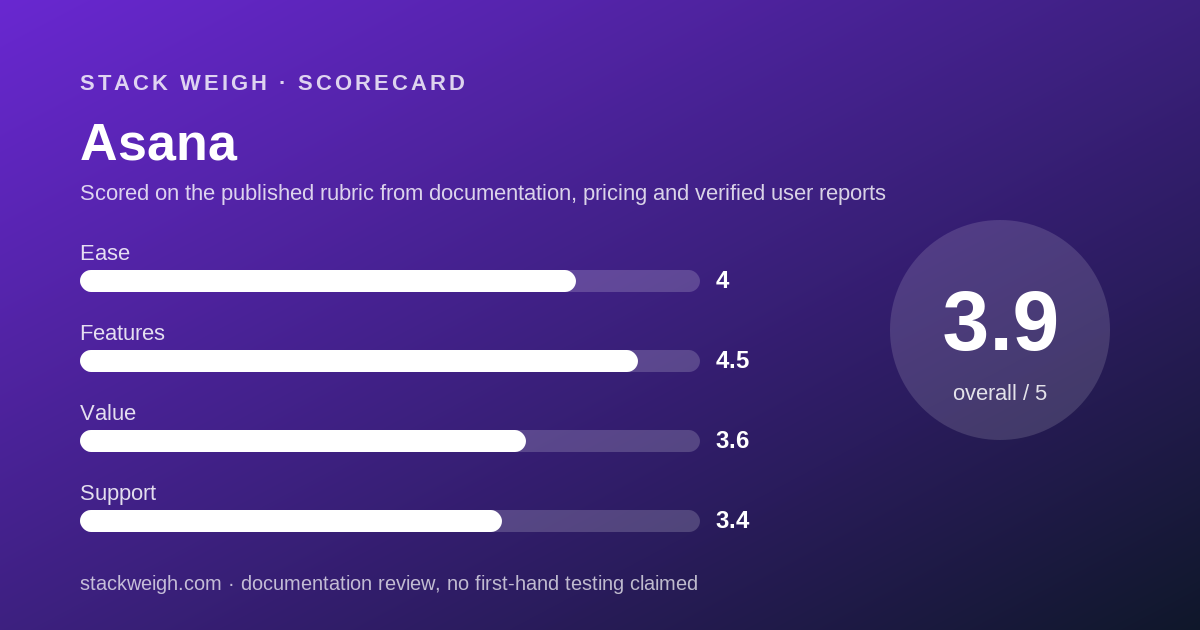
Scored on the published rubric, from documentation, pricing and verified user reports.
Best for: Teams of five to thirty that want both billing rates in writing and whose headcount lands on a multiple of five.
Verdict
Asana is the most readable of the three big work management price lists and the least forgiving once a team crosses a seat block. This is a documentation review built from the pricing page as displayed on October 29, 2026, not from direct use.
Four named tiers appear. Personal is US$0 for 2 users, Starter is US$10.99 per user per month, Advanced is US$24.99, and Enterprise carries no number at all. The same cards also print the monthly rates, US$13.49 and US$30.49.
That makes the annual discount checkable rather than inferred. By our arithmetic it lands at 18.5 percent on Starter and 18.0 percent on Advanced, which matches the page's own claim of up to 18 percent.
Value scores 3.6 because US$131.88 per seat per year on Starter is the dearest entry rate on this desk, and because the seat increment rule can bill a team of 21 for 25 seats. Support scores 3.4: the pricing FAQ states plainly that Asana does not offer refunds.
Visit Asana
We have no affiliate relationship with this vendor. Link goes to the official site.
Where it is strong
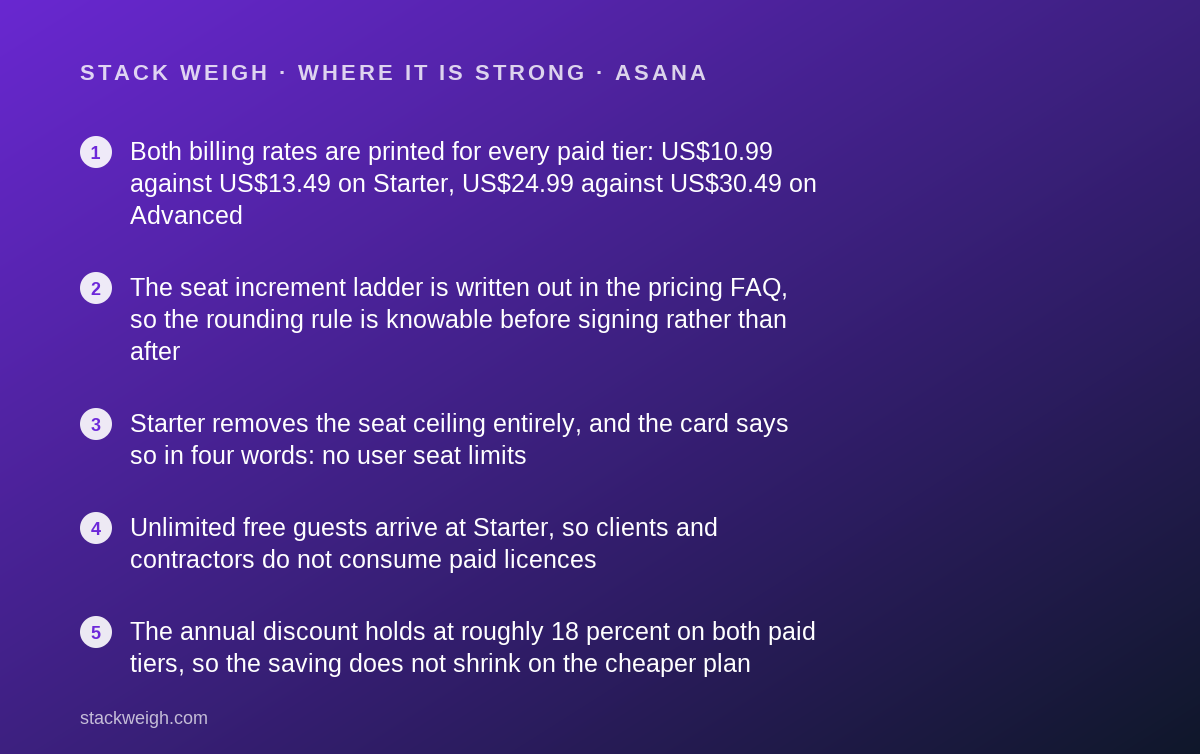
- Both billing rates are printed for every paid tier: US$10.99 against US$13.49 on Starter, US$24.99 against US$30.49 on Advanced
- The seat increment ladder is written out in the pricing FAQ, so the rounding rule is knowable before signing rather than after
- Starter removes the seat ceiling entirely, and the card says so in four words: no user seat limits
- Unlimited free guests arrive at Starter, so clients and contractors do not consume paid licences
- The annual discount holds at roughly 18 percent on both paid tiers, so the saving does not shrink on the cheaper plan
- The structured product data in the page markup carries the same US$10.99 and US$24.99 figures as the visible cards, so the two can be checked against each other
Where it falls short
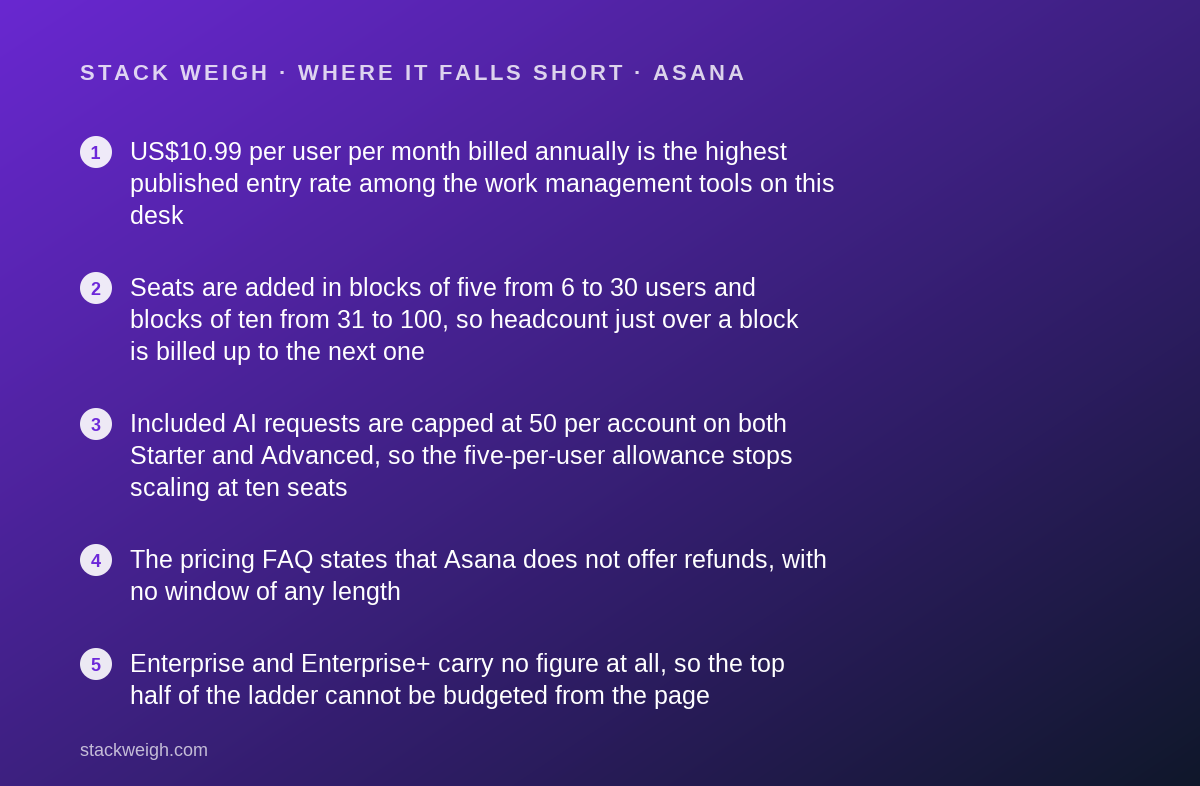
- US$10.99 per user per month billed annually is the highest published entry rate among the work management tools on this desk
- Seats are added in blocks of five from 6 to 30 users and blocks of ten from 31 to 100, so headcount just over a block is billed up to the next one
- Included AI requests are capped at 50 per account on both Starter and Advanced, so the five-per-user allowance stops scaling at ten seats
- The pricing FAQ states that Asana does not offer refunds, with no window of any length
- Enterprise and Enterprise+ carry no figure at all, so the top half of the ladder cannot be budgeted from the page
- No trial length appears anywhere on the pricing page as read on October 29, 2026
At a glance
| Starting price | US$0 on Personal, capped at 2 users. First paid tier is Starter at US$10.99 per user per month billed annually |
|---|---|
| Pricing note | From US$10.99 per user per month on Starter billed annually, against US$13.49 billed monthly, with paid plans starting at two seats and seat blocks widening to 5, 10, 25 and 50 as headcount grows (pricing page, checked October 29, 2026) |
| Monthly-billing price | US$13.49 on Starter and US$30.49 on Advanced, printed on the same cards as the annual rates |
| Annual cost per seat | US$131.88 on Starter and US$299.88 on Advanced, by our arithmetic from the published monthly figures |
| Free plan | Yes. Personal, labelled free forever, limited to 2 users |
| Seat minimum | Paid plans are described as designed for 2 members, and the seat increment ladder begins at 2 users |
| Seat increments | 1 seat between 2 and 5 users, then 5 up to 30 users, 10 up to 100, 25 up to 500 and 50 above that |
| Seat maximum | 2 on Personal. Starter and above are listed with no user seat limits |
| Guests | Unlimited free guests from Starter. View-only licences appear only on Enterprise |
| AI pricing unit | The request. Five included per user per month, capped at 50 per account on Starter and Advanced and 250 on Enterprise |
| Extra AI | US$0.50 per request on prepaid usage packs, or US$0.60 per request on pay-as-you-go billed monthly in arrears |
| Trial | No length stated on the pricing page as read on October 29, 2026 |
| Refunds | None. The pricing FAQ states that Asana does not offer refunds |
| Tax | State and local sales tax applied on the billing address, with VAT and GST per local rules |
What Asana actually charges for
Asana sells licences, not usage. The unit is one user per month, and every paid feature is attached to a tier rather than metered.
That makes the bill predictable once headcount is fixed. It also means one extra person can cost more than one seat, because seats are sold in blocks.
The four named tiers are Personal, Starter, Advanced and Enterprise, with an Enterprise+ edition described in a footnote below the cards. Only the middle two carry prices.
If per-seat lists are new to you, our guide to reading a per-seat pricing page sets out the five fields that actually move the invoice.
Who the Asana price list fits
Asana suits buyers who know their headcount a year ahead and want the annual and the monthly rate side by side before signing anything.
The pattern below is drawn from what the page prices rather than from what the product is marketed as doing.
- Teams of 5 to 30 whose headcount lands on a multiple of five, where the seat increment rule costs nothing
- Agencies and studios that need to seat clients at no cost, which Starter covers with unlimited guests
- Operations teams that want portfolios, goals and capacity planning in a priced tier rather than a quote
- Finance teams that need both billing rates in writing to weigh a monthly against an annual commitment
- Organisations that would rather upgrade one team than the whole account, which the pricing FAQ allows
Who should pass on Asana
Three groups are better served elsewhere, and all three reasons sit on the pricing page rather than in the product.
- Single-seat buyers, because paid plans are described as designed for 2 members and the increment ladder starts at 2
- Teams of 21 to 24, or 31 to 39 people, who are billed up to the next seat block
- Buyers who need a refund path, which the pricing FAQ removes entirely
What the Personal plan includes at US$0
Personal is free forever and holds 2 users. The feature table is blunt about it: up to 2 seats per project and team.
Inside that limit the plan is not thin. Unlimited tasks and projects, list, board and calendar views, unlimited storage at 100MB per file, status updates and more than 100 integrations are all listed.
What is missing is everything that makes a plan a team plan. Timeline and Gantt views, reporting dashboards, unlimited automations, forms, custom fields and custom templates all begin at Starter.
A two-person team can genuinely run on US$0 here. A third person ends the free ride, and that is the sharpest single step in the whole list.
How the paid tiers are priced, as of October 2026
Starter is US$10.99 per user per month billed annually, or US$13.49 billed monthly. Advanced is US$24.99 annually, or US$30.49 monthly. Both pairs are printed on the plan cards.
Our arithmetic turns those into US$131.88 and US$299.88 per seat per year on annual billing, against US$161.88 and US$365.88 on monthly billing.
The saving is US$30.00 a seat a year on Starter and US$66.00 on Advanced, which is 18.5 and 18.0 percent. The page's own banner claims up to 18 percent, so the claim holds.
Enterprise and Enterprise+ carry no figure. Both route to a sales contact, which means the top half of the ladder cannot be budgeted from the page at all.
When a vendor prices one half of its list and quotes the other, the method in turning a pricing page into a bill is the only way to reach a comparable number.
The seat block rule is the part that moves the bill
This is the field most buyers miss, and to Asana's credit it is published. The pricing FAQ sets out exactly how seats may be added.
Between 2 and 5 total users, seats go up one at a time. Up to 30 users they go up in fives. Up to 100 in tens, up to 500 in twenty-fives, and above 500 in fifties.
So a team of 21 cannot buy 21 seats. It buys 25. On Starter our arithmetic puts that at US$3,297.00 a year rather than US$2,769.48, an extra US$527.52 for four seats nobody uses.
At the next step the rounding gets dearer. A team of 51 buys 60 seats, which is US$7,912.80 against US$6,725.88, an extra US$1,186.92 a year.
The rule is neither hidden nor unusual. It is simply the difference between the sticker price and the invoice, which is the whole subject of comparing quotes priced in different units.
Asana prices AI by the request, and the included pool stops growing at ten seats
The AI unit here is the request, not the credit. One request is one successful unit of work by an AI Teammate or by Asana Dash, per the pricing FAQ.
Starter and Advanced include five requests per user per month, capped at 50 per account. Enterprise and Enterprise+ include the same five per user, capped at 250 per account.
Read the cap, not the allowance. At ten seats on Starter the account is already at its ceiling. At twenty seats the effective allowance is 2.5 requests per user, and at fifty seats it is one.
Beyond the pool, prepaid packs are US$0.50 per request and pay-as-you-go is US$0.60 per request billed monthly in arrears. Failed, timed-out and cancelled tasks are stated not to count.
A separate AI Studio allowance is listed per billing account per month: 50,000 credits on Starter, 75,000 on Advanced and 200,000 on Enterprise. That is an account pool too, so it also thins out as seats grow.
Anything metered needs a ceiling before it needs a budget, which is the point of budgeting for usage-based pricing.
Ease of use: 4.0, judged on how the price list reads
This score covers the buying experience, not the software. Grades on this desk come from documentation and pricing pages rather than from direct use.
Asana's page scores well on three counts. Both billing rates render as plain text, the comparison table marks every row as included, trial, opt-in or a number, and the seat increment ladder is written out in full.
It loses points on two. The AI request cap sits in an FAQ answer rather than on the plan card, and the AI Studio credit lines carry a typo that makes them easy to misread.
One more thing counts in its favour. The structured product data embedded in the page markup carries the same US$10.99 and US$24.99 figures as the visible cards, so the two confirm each other.
Features: what the 4.5 is built from
Features scores highest of the four pillars because the paid tiers are unusually complete for the money, and because the feature table is specific rather than suggestive.
Starter adds timeline and Gantt views, reporting dashboards, unlimited automations, forms, custom templates, custom fields and unlimited free guests.
Advanced adds unlimited portfolios, goals, resource management, approvals and proofing, form branching, time tracking and connectors for Salesforce, Tableau and Power BI.
Enterprise adds the identity and governance layer: SAML authentication, SCIM provisioning, universal resource management, capacity planning, service accounts, view-only licences and project admin controls.
View-only licences appearing only at Enterprise matters for seat arithmetic. Teams that want read-only stakeholders without paying for them have to use the free guest route instead, which is a different permission model.
Value: 3.6, because this is the dearest entry rate on the desk
US$131.88 per seat per year is the highest published entry rate among the work management tools we have priced, as of October 29, 2026.
The gap is modest at five seats. It is US$659.40 a year on Starter against US$540.00 for a US$9 per seat monthly rate billed annually, by our arithmetic.
At fifty seats the same gap compounds to US$6,594.00 against US$5,400.00. That is US$1,194.00 a year for exactly the same headcount.
Advanced is a steeper ask. US$299.88 a seat a year puts a twenty-person team at US$5,997.60, which is where portfolio and capacity features need a business case rather than a preference.
The counterweight is disclosure. Asana prints two billing rates, publishes its seat rounding rule and names its tax treatment, which is more than most lists on this desk manage.
Support: 3.4, and the refund line is the reason
The pricing FAQ answers the refund question in one sentence. Asana does not offer refunds, and cancelling keeps paid features only until the subscription expires.
That is a clear policy, and it is worse for buyers than a window would be. An annual commitment made in error runs to term.
No trial length appears on the pricing page as read on October 29, 2026, so the free Personal plan is the only no-cost way to look inside.
The page does state that eligible nonprofit organisations get a discount on an annual Starter or Advanced plan, and that student groups should make contact. Neither discount carries a percentage.
Tax is addressed directly. State and local sales tax is applied to the total based on the billing address, with VAT, GST and other taxes applied under local law.
Alternatives worth pricing against Asana
Asana competes on completeness rather than on entry price, so the right comparison depends entirely on how many seats you are buying.
Choose a per-seat tool with a lower entry rate if headcount is the only variable and the feature list you need stops at boards, timelines and dashboards.
Choose Asana if the seat count is stable, lands on a block boundary, and you need portfolios, goals and capacity planning without entering a sales process.
If the work is mostly documents rather than tasks, the pricing question changes shape. Our Notion review and Confluence review price that category, and Notion against Confluence sets the two lists side by side.
If the work is mostly conversation, Slack is the per-seat list to beat, and it shares Asana's habit of pricing seats and metering extras separately.
For a worked example of the same seat-count method in a different category, choosing a password manager plan by seat count runs the arithmetic at 1, 5, 20 and 50 people.
Bottom line
Asana is the most readable of the big three work management price lists and the most expensive place to start. Both facts come from the same page.
At two users it is free. At a headcount that lands on a multiple of five it is fair. At 21 or 51 people it quietly bills for 25 or 60 seats.
Budget US$131.88 per seat per year on Starter and US$299.88 on Advanced, add sales tax, and assume no refund if the fit turns out to be wrong.
Buy it if
- You want both billing rates in writing before you commit, because Asana prints the monthly and the annual figure on the same card
- Your headcount lands on a multiple of five between 5 and 30 users, where the seat increment rule costs you nothing
- You need to seat clients or contractors at no cost, which Starter covers with unlimited free guests
- You want portfolios, goals and resource management without a sales call, which Advanced bundles at US$24.99 per user per month billed annually
Skip it if
- Your headcount sits just above a seat block, because 21 users are billed as 25 seats, which our arithmetic puts at US$527.52 extra a year on Starter
- You expect a refund if the fit is wrong, since the pricing FAQ rules refunds out entirely
- You plan to lean on the included AI allowance, where the 50-request account cap starts biting at the eleventh seat
Frequently asked
How much does Asana cost for a 10-person team?
US$1,318.80 a year on Starter at US$10.99 per user per month billed annually, or US$2,998.80 on Advanced at US$24.99. Both are our arithmetic from the pricing page checked October 29, 2026, before sales tax.
Does Asana have a free plan?
Yes. Personal is listed at US$0 and labelled free forever, but the feature table caps it at 2 seats per project and team. Unlimited tasks and projects, list, board and calendar views are included, checked October 29, 2026.
Is annual billing worth it on Asana?
The page claims up to 18 percent. Our arithmetic from the printed figures gives 18.5 percent on Starter, US$131.88 against US$161.88 a seat a year, and 18.0 percent on Advanced, US$299.88 against US$365.88.
Can I buy exactly 21 Asana seats?
No. The pricing FAQ states that seats are added in increments of five up to 30 total users, so 21 people are billed as 25 seats. On Starter that is US$3,297.00 rather than US$2,769.48 a year, by our arithmetic.
Does Asana refund an unused annual plan?
No. The pricing FAQ states that Asana does not offer refunds, and that cancelling keeps paid features until the subscription expires. No refund window of any length appears on that page as of October 29, 2026.
How much does Asana AI cost beyond the included requests?
US$0.50 per request on prepaid usage packs, or US$0.60 per request on pay-as-you-go billed monthly in arrears. The included allowance is five requests per user per month, capped at 50 per account on Starter and Advanced.
What does Asana Enterprise cost?
The pricing page carries no figure. Enterprise and Enterprise+ both route to a sales contact, so the top two tiers cannot be budgeted from published pricing as read on October 29, 2026.
Sources
- Asana pricing page: plan cards, plan comparison table and pricing FAQ - checked October 29, 2026
- Structured product and offer data embedded in the Asana pricing page markup - checked October 29, 2026
Visit Asana
We have no affiliate relationship with this vendor. Link goes to the official site.