 Stack
Asana vs monday.com vs ClickUp: the bill at four sizes
Three work management price lists, modelled at 1, 5, 20 and 50 seats from the published rates as displayed on October 29, 2026. ClickUp wins, narrowly, and not on headline rate. monday.com matches ClickUp to the cent at US$9 a seat a month on annual billing. It just refuses to sell below three seats or publish above forty. Asana costs 22.1 percent more per seat on its entry tier, by our arithmetic, and is the only one of the three that tells you how it rounds seats and what tax it will add. These are documentation comparisons. Figures come from the three pricing pages and the structured data inside them, not from direct use.
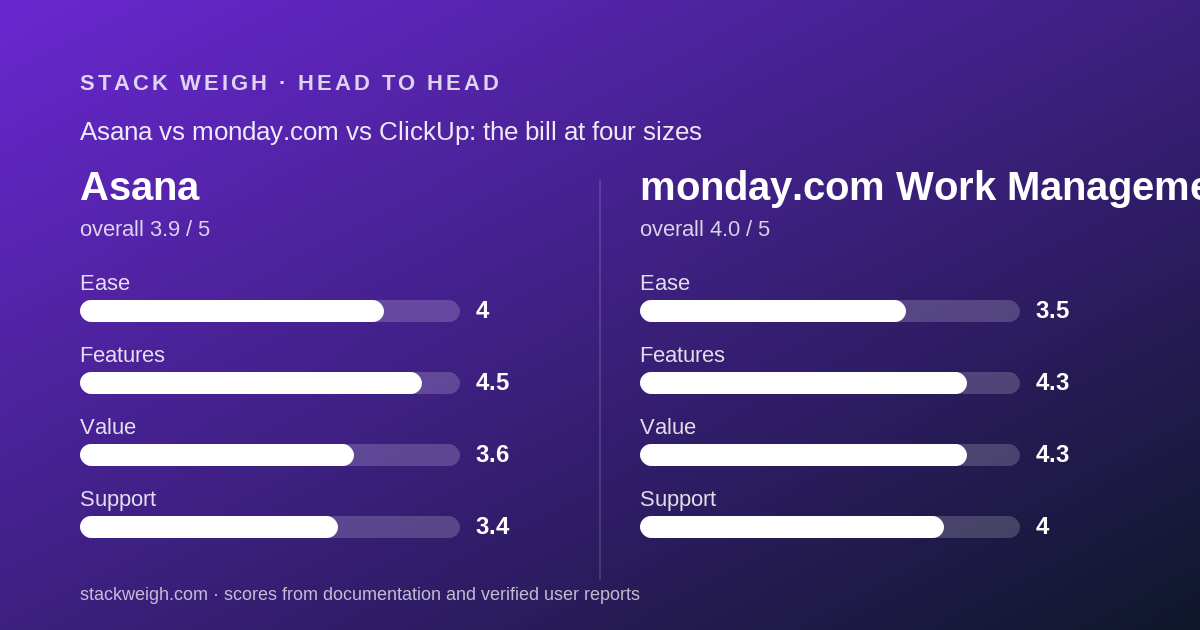
 3.9Asana
 4.0monday.com Work Management
 4.3ClickUp
Specification by specification
| Spec | Asana | monday.com Work Management | ClickUp |
|---|---|---|---|
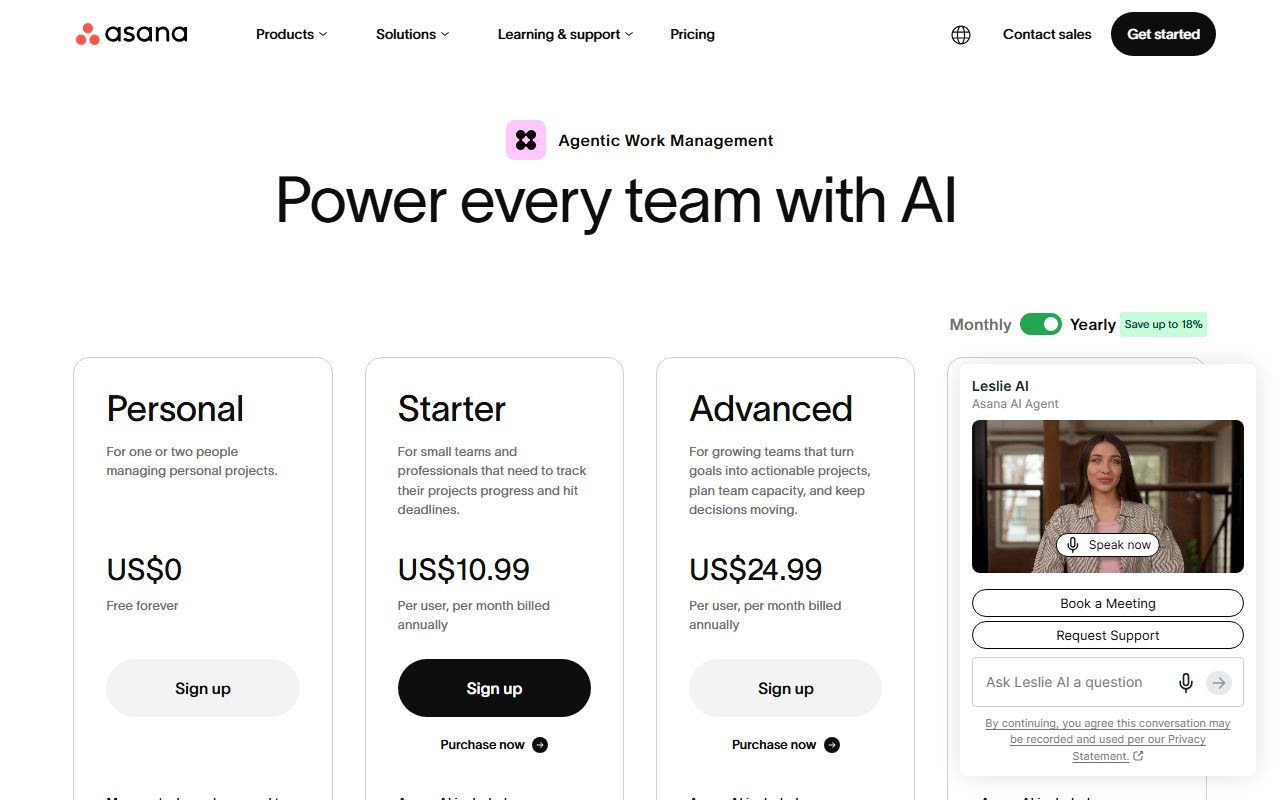
| Entry paid rate | US$10.99 per user per month billed annually | US$9 per seat per month billed annually | US$9 per user per month billed yearly |
| Annual cost per seat, entry tier | US$131.88 | US$108.00 | US$108.00 |
| Monthly-billed rate, entry tier | US$13.49, printed on the plan card | US$12, in the page markup only | Could not be read on October 29, 2026 |
| Annual cost per seat, mid tier | US$299.88 on Advanced | US$228.00 on Pro | US$204.00 on Business |
| Free plan | Yes, 2 users, labelled free forever | Yes, 2 seats, 3 boards, 3 Docs | Yes, unlimited members, 60MB storage, 5 Spaces |
| Seat minimum on a paid plan | 2 users | 3 users | None stated |
| Highest seat count with a published price | No limit stated above Starter | 40 users, then a quote | No limit stated |
| Seat increments | 1 to 5 users, then 5, 10, 25 and 50 | Not stated on the page | Not stated on the page |
| Cheapest paid bill for one person, per year | US$263.76, because 2 seats is the floor | US$324.00, because 3 seats is the floor | US$108.00 |
| Entry tier at 5 seats, per year | US$659.40 | US$540.00 | US$540.00 |
| Entry tier at 20 seats, per year | US$2,637.60 | US$2,160.00 | US$2,160.00 |
| Entry tier at 50 seats, per year | US$6,594.00 | Not published above 40 users | US$5,400.00 |
| Free read-only people on a paid tier | Unlimited free guests from Starter | Unlimited free viewers from Basic | Guest permissions from Core, with no free or unlimited claim |
| AI pricing unit | The request. 5 per user, capped at 50 per account | The credit. 1,000 a month per account on Basic | The credit. 1,000 per user per month, pooled |
| Refund policy | None. The FAQ states no refunds | Remaining balance, if cancelled within 30 days | Full refund within 30 days |
| Trial | No length stated on the pricing page | 14 days on the Pro plan | No length stated for the trial-marked features |
| Can part of an account be upgraded | Yes. The FAQ allows upgrading one team | Not stated on the page | No. The whole Workspace must be upgraded |
| Top tier price | Enterprise and Enterprise+ both quoted | Enterprise quoted, discounts available | Enterprise quoted; Max published at US$100 per user per month |
The short answer depends on how many seats you are buying
There is no single winner across the whole range, because the three lists are built to different shapes. Here is the ranking at each of our four modelling points.
- 1 seat: ClickUp at US$108 a year is the only option. Asana floors at 2 seats and monday.com at 3
- 5 seats: monday.com and ClickUp tie at US$540 a year. Asana is US$659.40
- 20 seats: another tie at US$2,160. Asana is US$2,637.60, or 22.1 percent more
- 50 seats: ClickUp at US$5,400 against Asana at US$6,594. monday.com stops publishing above 40 users
- Any size, mid tier: ClickUp Business at US$204 a seat a year sits 10.5 percent below monday.com Pro and 32.0 percent below Asana Advanced
How these three price lists were read
Every figure below was taken as a literal string from the vendor's own pricing page, rendered in a browser so that prices drawn by script appear, and then checked against a second source on the same page wherever one exists.
For Asana that second source is the structured product data in the page markup, which carries the same US$10.99 and US$24.99 figures as the visible cards.
For monday.com it is the structured pricing data, which confirms the annual rates of US$9, US$12 and US$19 and adds monthly rates the cards do not show.
For ClickUp there is no second source. The yearly rates appear once, and the struck-through figures carry no billing period, so the monthly column of this comparison stays empty.
Annual costs per seat are our arithmetic: the published monthly rate multiplied by twelve. Where a vendor states a seat minimum, the modelled bill uses the minimum rather than the headcount.
No part of this comparison comes from direct use of the three products. It is a reading of three pricing pages on one day, October 29, 2026, and prices change.
At one seat, only ClickUp has a product to sell
This is the clearest result in the comparison and the one least likely to appear in a feature table.
ClickUp's pricing page states no seat minimum. Core at US$9 per user per month billed yearly therefore costs US$108 a year for one person, by our arithmetic.
Asana's pricing FAQ describes paid plans as designed for 2 members, and its seat increment ladder starts at 2. The smallest paid purchase is two seats, or US$263.76 a year on Starter.
monday.com's FAQ is blunter still: plans start from 3 users. One person pays for three seats, which is US$324 a year on Basic.
So the cheapest first paid seat in this category costs US$108, US$263.76 or US$324 depending on the logo, for rates that differ by less than two dollars a month.
Minimums are the field buyers skip and invoices do not. Our guide to reading a per-seat pricing page puts the minimum ahead of the rate for exactly this reason.
At five and twenty seats, monday.com and ClickUp tie to the cent
Both charge US$9 per seat per month on annual billing. Our arithmetic makes that US$108 a seat a year in both cases.
At five seats, both are US$540 a year. At twenty, both are US$2,160. The entry tiers are indistinguishable on price.
So the choice in that band is not financial. It comes down to three structural differences the price lists do publish.
monday.com gives unlimited free viewers from Basic upward. ClickUp bills every member of the Workspace once it is upgraded, with no free viewer tier stated.
ClickUp prorates seats added mid-cycle. monday.com's FAQ describes payment as one upfront instalment for the term, and says nothing about proration.
ClickUp refunds in full within 30 days. monday.com refunds the remaining balance within 30 days, which on a January purchase cancelled in February is a very different number.
At fifty seats, monday.com leaves the table
monday.com's pricing FAQ routes any account above 40 users to a sales quote. There is no published 50-seat figure as of October 29, 2026.
That is a defensible commercial choice and a real problem for a buyer building a budget. Two of the three lists answer the question and one does not.
ClickUp Core at fifty seats is US$5,400 a year. Asana Starter is US$6,594, a difference of US$1,194 for identical headcount.
On mid tiers the fifty-seat gap widens. ClickUp Business is US$10,200 a year against Asana Advanced at US$14,994.
Asana adds its own complication at that size. Seats go up in tens between 31 and 100 users, so a team of 51 buys 60 seats: US$7,912.80 rather than US$6,725.88, by our arithmetic.
A quote and a published rate are not the same kind of number. Comparing quotes priced in different units is the method for putting them in one column anyway.
Asana costs more per seat and explains itself far better
Asana is 22.1 percent above the other two on entry rate and it is the only one of the three whose price can be fully reconstructed from its own page.
It prints both billing rates on every paid card: US$10.99 against US$13.49 on Starter, US$24.99 against US$30.49 on Advanced.
Our arithmetic on those pairs gives savings of 18.5 and 18.0 percent, which matches the page's own claim of up to 18 percent. The claim survives checking.
Neither rival manages that. monday.com's annual rates appear on the cards while the monthly rates sit only in the page markup, and the savings they imply are 25.0, 14.3 and 20.8 percent against a flat claim of 18 percent.
ClickUp strikes through US$12, US$25 and US$120 as a regular price without saying whether that is the monthly rate, and the monthly view could not be read at all.
Asana also publishes its seat rounding ladder and names its tax treatment. For 22 percent more per seat, a buyer gets a price list that can be audited.
The mid tiers reverse nothing, they just widen the gap
Entry tiers are where two of the three tie. Mid tiers are where the ranking becomes clear.
ClickUp Business is US$17 per user per month billed yearly, or US$204 a seat a year. monday.com Pro is US$19, or US$228. Asana Advanced is US$24.99, or US$299.88.
At twenty seats that is US$4,080, US$4,560 and US$5,997.60 a year. Asana Advanced costs 47.0 percent more than ClickUp Business for the same headcount, by our arithmetic.
The tiers are not identical in content, which is the honest caveat. Asana Advanced carries portfolios, goals, resource management, approvals and proofing, and connectors for Salesforce, Tableau and Power BI.
ClickUp Business carries advanced dashboards, webhooks, 10,000 automations a month, resource management, timesheets and Gantt chart PDFs. monday.com Pro carries 20 workflows and 25,000 automation actions a month.
All three keep single sign-on with SAML, SCIM provisioning and audit logs for an unpriced tier. If identity integration is mandatory, none of the three has published a number you can budget.
Free read-only people are the biggest saving, and only two of the three offer it
Seat arithmetic changes shape when a tool distinguishes people who edit from people who only watch.
monday.com gives unlimited free viewers from Basic upward, described as read-only access with no editing rights. A team of six doers and twenty watchers pays for six seats.
Asana gives unlimited free guests from Starter upward, and the card is explicit that guests do not increase the licence count. View-only licences, a separate thing, appear only at Enterprise.
ClickUp advertises unlimited free members on Free Forever, which is not the same claim. Once the Workspace is upgraded, the pricing FAQ states that all members are upgraded and billed.
ClickUp does list guest permissions from Core, but the page makes no free or unlimited claim about them as read on October 29, 2026.
Take a team of 5 editors and 20 read-only stakeholders. At entry tier our arithmetic gives monday.com US$540 a year and Asana US$659.40, because only the five editors are licensed.
ClickUp, with all 25 people in one upgraded Workspace, comes to US$2,700 a year. That is five times the monday.com figure for exactly the same group of people.
That single difference is larger than every rate difference in this comparison combined. The method for finding it on any pricing page is in turning a pricing page into a bill.
Three vendors, three AI units, and only one that grows with the bill
None of the three prices AI the same way, which makes the allowances impossible to compare without converting them first.
Asana meters by the request. Five are included per user per month, capped at 50 per account on Starter and Advanced. At twenty seats that cap is 2.5 requests per person; at fifty it is one.
monday.com meters by the credit and gives 1,000 a month on Basic at its 10-seat default. The card prices those credits at US$10 and then removes the charge with a special discount of exactly US$10.
ClickUp meters by the credit too, but awards 1,000 per user per month, pooled. A twenty-seat Core Workspace holds 20,000 credits a month, so the allowance scales with the invoice.
That is the only one of the three where growing the team grows the AI budget rather than diluting it.
Overage pricing is published by Asana alone: US$0.50 a request prepaid, US$0.60 pay-as-you-go. Neither rival publishes a credit top-up rate.
Any metered line needs a ceiling before it needs a budget, which is the whole argument of budgeting for usage-based pricing.
Only ClickUp will give the money back
Refund terms are the cheapest thing a vendor can publish and the three lists treat them completely differently.
ClickUp states a 100 percent satisfaction guarantee with a full refund inside 30 days of purchase.
monday.com refunds the remaining balance of a yearly subscription cancelled within 30 days, automatically from the admin section. Downgrades after that window are not refunded.
Asana's pricing FAQ says the company does not offer refunds at all. Cancelling keeps paid features until the term ends, then access to paid features stops.
Trials line up the same way. monday.com publishes 14 days on the Pro plan. Asana publishes no trial length on its pricing page. ClickUp marks features as trial in its table without stating a duration.
For an annual commitment at twenty seats, those three policies are worth up to US$2,160, US$4,560 or nothing depending on which logo signed the invoice.
What none of the three publishes, and why it matters
Three gaps are common to all three price lists, and each one can move a mid-market bill by a wider margin than the rate difference between them.
The first is the top tier. Asana quotes Enterprise and Enterprise+, monday.com quotes Enterprise, ClickUp quotes Enterprise. Single sign-on with SAML, SCIM provisioning and audit logging sit behind those quotes in all three cases.
So any organisation with a mandatory identity requirement is comparing three sales conversations, not three price lists. The published rates describe the tier below the one such a buyer will sign.
The second gap is overage. Asana alone publishes a per-request rate beyond the included pool. Neither rival publishes a credit top-up price, so the cost of exceeding the allowance is unknown on two of the three.
The third gap is contract term. All three describe annual billing as a single upfront payment, and none publishes a mid-term exit other than the refund windows above.
None of this makes the comparison useless. It does mean the honest version of the answer is a range with two sales calls attached, which is why we publish the arithmetic rather than a single verdict figure.
Choose Asana if, choose monday.com if, choose ClickUp if
All three are credible at mid-market headcounts. The deciding factors are structural, not featural.
- Choose Asana if your headcount lands on a multiple of five, you need portfolios and capacity planning without a sales call, and you want a price list you can audit line by line
- Choose Asana if a large number of external collaborators need free access and the internal team is small and stable
- Choose monday.com if you sit between 3 and 40 seats, want the cheapest published rate, and have far more watchers than doers
- Choose monday.com if automation volume matters and you will pay for Pro, where the ceiling jumps from 250 to 25,000 actions a month
- Choose ClickUp if you are buying fewer than three seats, expect to add people mid-term, or want one published rate from one seat to fifty
- Choose ClickUp if the AI allowance must scale with the team, or if a refund path on an annual commitment is non-negotiable
Bottom line: ClickUp by structure, not by rate
ClickUp takes it because it is the only list here with an answer at every seat count we model, a full refund term, and an AI allowance that grows with the bill.
monday.com matches it on rate exactly and loses on two boundaries, below three seats and above forty, plus a saving claim we could not reproduce.
Asana is the most expensive and the most transparent. For teams that need Advanced features and sit on a seat block, that trade is defensible.
If the real work is documents rather than tasks, this is the wrong category to be comparing. Start with Notion against Confluence instead.
And if you want the same arithmetic run at a fixed headcount in that category, the cheapest team wiki for a ten-person team does it end to end.
Frequently asked
Which is cheapest for a 10-person team?
monday.com Basic and ClickUp Core tie at US$1,080 a year, both at US$9 a seat a month billed annually. Asana Starter is US$1,318.80. All three are our arithmetic from pricing pages checked October 29, 2026.
Which of the three will sell me a single seat?
Only ClickUp. Its page states no seat minimum, so Core costs US$108 a year for one person. Asana floors at 2 seats, US$263.76, and monday.com at 3 seats, US$324.
Which has the best free plan?
ClickUp's, if storage is not the constraint: unlimited tasks and unlimited free members against 60MB and 5 Spaces. Asana and monday.com both cap their free plans at 2 people.
Which is cheapest at 50 seats?
ClickUp Core at US$5,400 a year against Asana Starter at US$6,594, by our arithmetic. monday.com publishes no price above 40 users, so it cannot be compared at that size.
Can I switch between them without losing the annual discount?
Only ClickUp publishes a full 30-day refund. monday.com refunds the remaining balance inside 30 days. Asana's pricing FAQ states no refunds, so an Asana year runs to term.
Sources
- Asana pricing page: plan cards, feature table and pricing FAQ - checked October 29, 2026
- monday.com pricing page and the structured pricing data in its markup - checked October 29, 2026
- ClickUp pricing page: plan cards, full feature comparison and pricing FAQ - checked October 29, 2026
Visit Asana
We have no affiliate relationship with this vendor. Link goes to the official site.
Visit monday.com Work Management
We have no affiliate relationship with this vendor. Link goes to the official site.
Visit ClickUp
We have no affiliate relationship with this vendor. Link goes to the official site.