 Stack
Stack
airSlate SignNow
E-signature priced per account rather than per seat, with unlimited free team members and a signature-invite cap that is the real limit
Scored on the published rubric, from documentation, pricing and verified user reports.
Best for: Teams of any size whose whole organisation sends fewer than about 100 agreements a year, and who would rather pay for volume than for headcount.
Verdict
SignNow is the odd one out on this desk, and that is the whole point of reviewing it. This is a documentation review built from the pricing page as displayed on October 13, 2026, not from direct use. Every other e-signature price list we read charges per seat. SignNow charges per account: the plan cards say unlimited users and the feature list says add unlimited team members to your plan for free. What is capped instead is volume, and the FAQ is precise about it, stating that annual plans include up to 100 signature invites per account per year and monthly plans up to 10 per account per month. Starter is displayed at $8 a month billed annually against $20 billed monthly. By our arithmetic that is $96 a year for a team of 1 or a team of 50 alike. Value scores 4.5 because no other published structure in this category is close at low volume. The missing number is the pay-as-you-go rate past the cap, which the page names only for Enterprise at $1.50 per invite.
Visit airSlate SignNow
We have no affiliate relationship with this vendor. Link goes to the official site.
Where it is strong
- Both billing rates are printed on every card: $8 against $20 on Starter, $15 against $30 on Professional, $30 against $50 on Business
- Each card states the saving in dollars rather than percent, and the arithmetic checks out: $144, $180 and $240 a year respectively
- Team members are free and unlimited on every paid tier, so headcount does not appear in the bill at all
- The FAQ defines a signature invite carefully, including the awkward cases: a declined document still counts, a cancelled invite still counts, and merging or downloading does not count
- Enterprise volume pricing has a published floor of $1.50 per signature invite with stated volume discounts above it, which is more than most sales-led tiers disclose
Where it falls short
- The pay-as-you-go rate past the 100-invite allowance is not published for Starter, Professional or Business. The page only says the plan transitions to pay-as-you-go
- 100 invites a year is per account, not per user, so the allowance does not grow with the team the way per-seat allowances do
- The plan cards show a bare dollar sign with no currency code anywhere on the page, and the figures do not change when the page is read from outside the United States
- Single sign-on, phone support, HIPAA compliance and full API access all sit on Enterprise, which is a sales conversation
- The free trial is 7 days, the shortest on this desk, and there is no free tier at all outside a developer sandbox offer of 250 signature invites
What airSlate SignNow actually sells you
SignNow sells volume, not seats. That single sentence explains every figure on its price list and every reason to choose or reject it.
The four plan cards all carry the line unlimited users, and the feature list under each one repeats add unlimited team members to your plan for free.
There is no per-user rate on the page and no seat minimum, because the seat is not the billing unit.
What is metered is the signature invite. The FAQ states that annual plans include up to 100 signature invites per account per year, and monthly plans up to 10 per account per month.
This review reads the pricing page as displayed on October 13, 2026 through a headless browser, because the page redirects a direct fetch to a payment host that returns nothing readable.
It grades the pricing structure and what a team pays over a year. It does not describe how SignNow feels to operate; the editors have not run an account for this piece.
If you are comparing this against a per-seat quote, read comparing quotes priced in different units first, because the two are not the same shape.
Who SignNow is best for
An account-priced plan with a volume cap suits a very specific workload, and it is the opposite of the one per-seat tools suit.
- Organisations where many people need access but few agreements go out, such as a property manager, a clinic or a school office
- Teams of 20 or 50 whose total signing is under about 100 agreements a year, who would otherwise pay per seat for mostly idle licences
- Buyers who want the monthly and annual rates side by side with the yearly saving in dollars rather than percent
- Teams that need SMS delivery and signer authentication without reaching an enterprise contract, which Business covers at $30 a month
- Finance and invoicing workflows, since formula and conditional fields are on Business rather than reserved for Enterprise
- Anyone whose main worry is that a licence count will creep upward after signing
Who should skip it
Three profiles will find the cheap headline price turns into an unpriced one.
- High-volume senders of any size, because 100 completed invites a year is roughly 8 a month for the whole account and the overage rate below Enterprise is not published
- Teams that need single sign-on, phone support, HIPAA compliance or full API access, all of which the page places on Enterprise
- Buyers who need more than a week to evaluate, since the trial is 7 days
How the pricing is structured
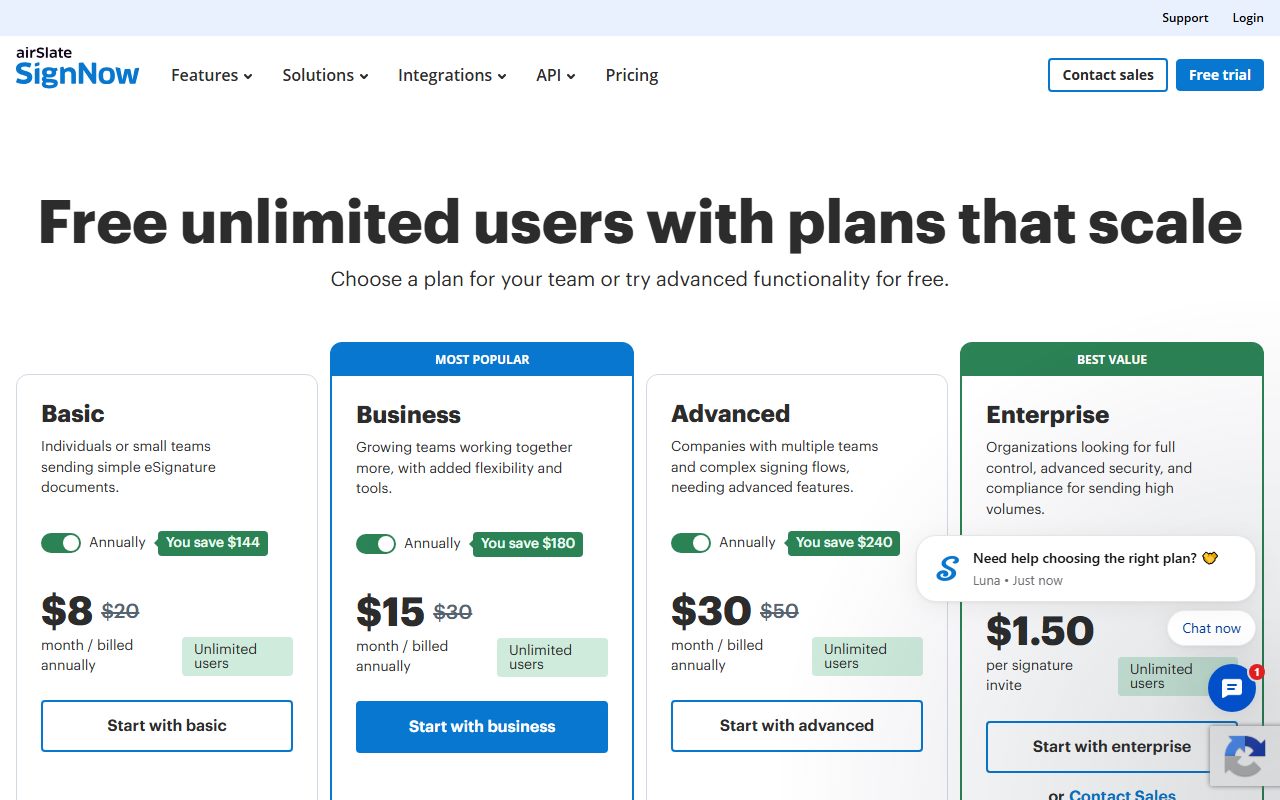
Four tiers, two billing periods, both printed. The toggle offers Annually with a banner reading save up to 60 percent, and the cards carry two figures each.
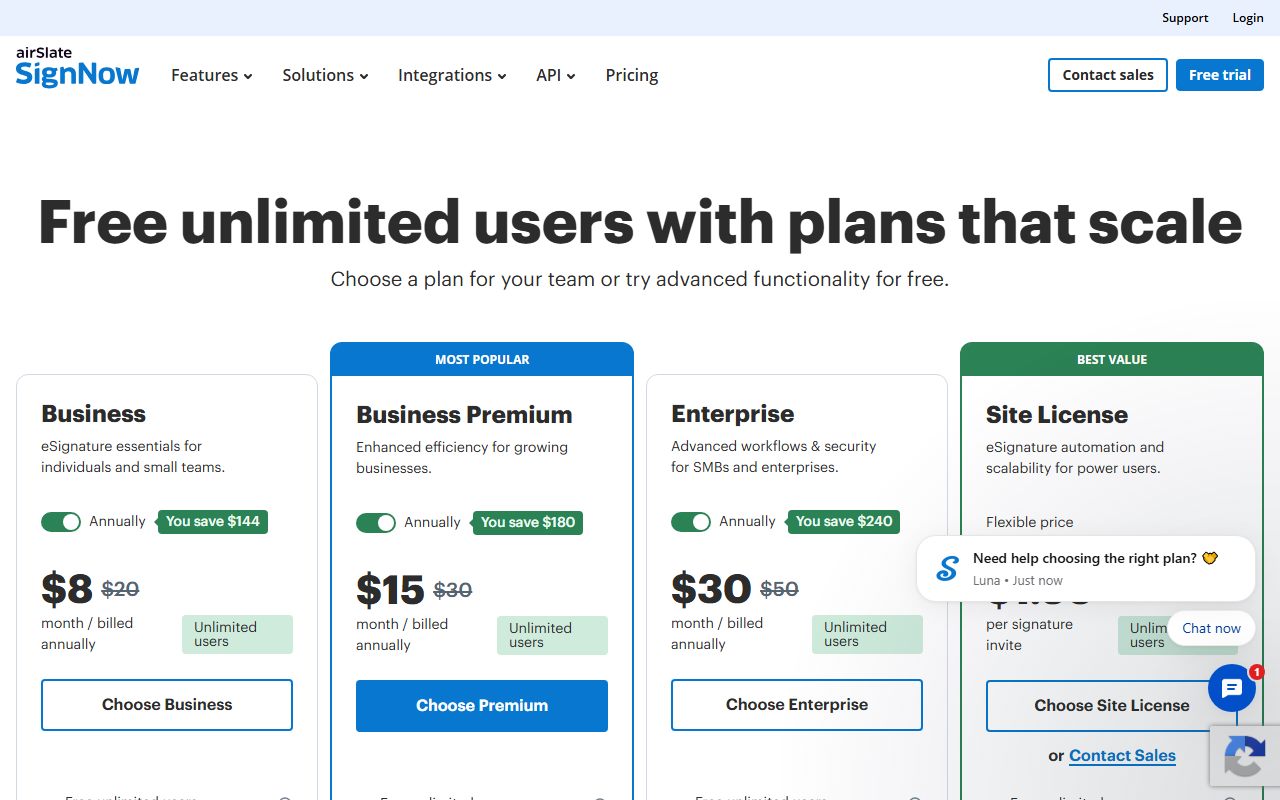
Starter shows $8 and $20 with the subtitle month, billed annually, and the note you save $144. Professional shows $15 and $30 with you save $180. Business shows $30 and $50 with you save $240.
All three savings check out as the monthly gap multiplied by twelve, which is a useful sign that the lower number is the annual-billing rate and the higher number is the month-to-month rate.
Enterprise is described as a flexible price, quoted from $1.50 per signature invite, with volume discounts above that and a Contact Sales button. That is the only tier where the volume rate is published and the subscription is not.
On currency: the page prints a bare dollar sign with no currency code anywhere, and the figures were identical when read from a non-US connection on October 13, 2026. We report what the page displays and do not convert anything. Confirm the currency at checkout.
What 1, 5, 20 and 50 people pay for 12 months
This is the shortest table on our e-signature desk, because headcount does not enter the arithmetic. The figures are editorial calculations from the displayed prices on October 13, 2026, excluding tax and overage.
- Starter billed annually: $96 a year at 1, 5, 20 or 50 people
- Starter billed monthly: $240 a year at any headcount
- Professional billed annually: $180 a year at any headcount; billed monthly, $360
- Business billed annually: $360 a year at any headcount; billed monthly, $600
- Included volume in every case: 100 completed signature invites per account per year on annual billing, or 10 per account per month on monthly billing
- Subscription cost per included invite: $0.96 on Starter, $1.80 on Professional and $3.60 on Business, all on annual billing
- Enterprise: from $1.50 per signature invite, with the subscription element quoted by sales
The invite cap is the number that decides everything
A flat account fee makes the price look unbeatable, so the cap deserves the same attention a per-seat buyer gives the seat count.
One hundred completed invites a year is about eight a month for the entire organisation. A 20-person sales team will pass that in a fortnight. A 20-person school office may not reach it in a year.
The FAQ is unusually careful about what counts, and the careful parts are the expensive parts. A declined document still counts as a completed invite. An invite cancelled before signature still counts. A document shared through an open invite link counts once per completed signature.
So the cap is not a measure of successful agreements. It is a measure of attempts, including failures, which is the direction that costs money.
Past the cap the FAQ says the plan transitions to pay-as-you-go and you pay only for the additional invites. It does not say what one costs. The only published figure in that neighbourhood is the Enterprise floor of $1.50.
That makes SignNow a plan to buy with a volume forecast in hand rather than a hope. Budgeting for usage-based pricing sets out how to put a ceiling on an unpriced metered line.
What each tier adds
The tiers stack rather than branch, which makes the upgrade decision simple.
Starter at $8 covers legally binding e-signatures with stated compliance under eIDAS, UETA and the ESIGN Act, unlimited templates, unlimited document storage, mobile apps and auto-reminders.
Professional at $15 adds bulk send, signing links, payment collection during signing, scheduled sending, team collaboration and team reports. For a team sharing templates and folders, this is the first tier that behaves like a team product.
Business at $30 adds custom branding, SMS document delivery, advanced signer authentication by password, SMS or phone call, formula fields, conditional fields and approval workflows.
Enterprise adds full API access, premium integrations with Salesforce, NetSuite, Microsoft Dynamics 365, Autodesk BIM 360 and Procore, industry compliance including HIPAA and 21 CFR Part 11, single sign-on, user management and phone support.
Note what sits in that last group. Single sign-on and phone support are not features a 20-person company is unlikely to want, and both are behind a quote.
Ease of use: what the score is built from
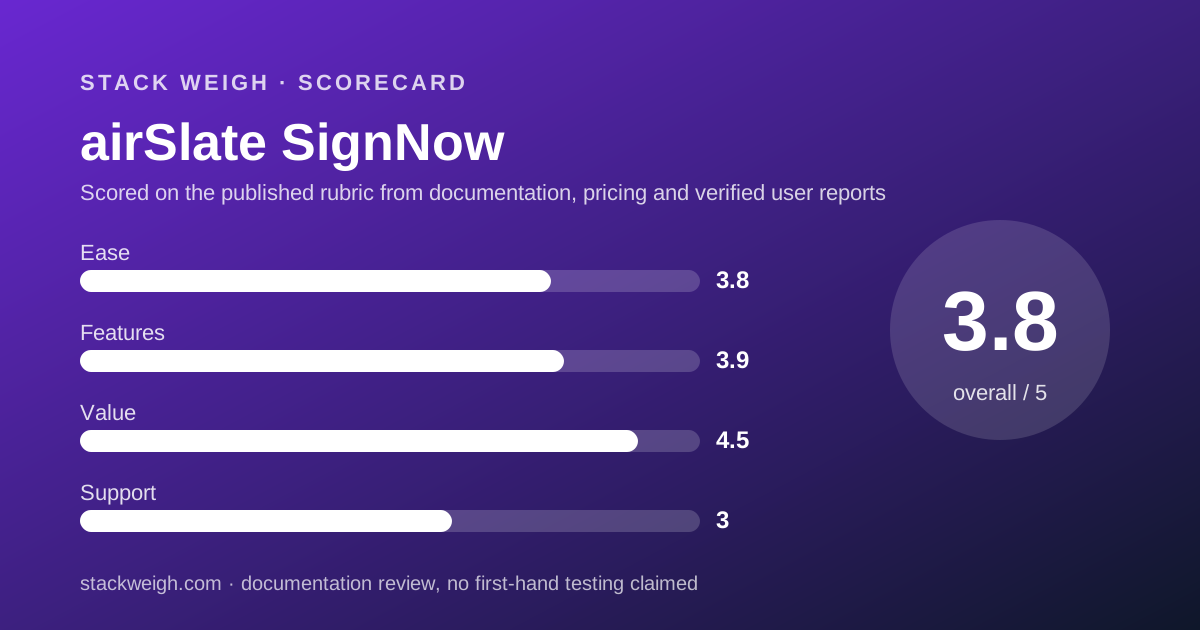
3.8 out of 5. This pillar grades the pricing page and the documented buying path, not the signing interface.
SignNow does the single most useful thing a price list can do: it prints both billing rates and states the annual saving in dollars, so no arithmetic is needed and no claim has to be trusted.
The invite definition in the FAQ is the clearest in this category.
The deductions are for two silences. The overage rate is absent below Enterprise, and the currency code is absent everywhere, which matters on a page whose only unit is a dollar sign.
A smaller deduction is for reachability. The published pricing URL redirects to a separate purchase host that returns an empty document to a direct fetch, so the page only resolves in a real browser.
Features: what the score is built from
3.9 out of 5. The documented set on Business is complete for straightforward signing and thin for workflow.
What is included early is generous: unlimited templates, unlimited storage, bulk send and payment collection from Professional, remote online notarisation listed in the feature matrix, and bulk invites driven from a CSV.
What is absent below Enterprise is the admin layer. Single sign-on, user management, industry compliance and the API are all on the quoted tier, so a company with an IT policy cannot stay on the price list.
The deduction reflects that split. For comparison, the broadest documented feature set we graded in this category puts payments, web forms and bulk send on a $45 per-user tier, and still puts single sign-on behind sales.
Value: what the score is built from
4.5 out of 5, the highest score on our e-signature desk, and it rests entirely on the account-priced structure.
At $96 a year for any number of people, Starter is the cheapest published route to compliant e-signature we have priced in this category. Business at $360 a year for an unlimited team undercuts a single seat of most per-seat alternatives at list price.
The arithmetic that decides whether that is real is cost per invite. Starter works out at $0.96 per included invite and Business at $3.60, against a per-seat rival whose Standard tier lands at $3.60 per included envelope by the same method.
So SignNow is not cheap per signature. It is cheap per person. A team of 50 sending 5,000 agreements a year would be priced out of SignNow's allowance and well served by a per-seat allowance.
The half point withheld is for the unpriced overage. A value score cannot be higher than the fraction of the bill you can actually model.
Support: what the score is built from
3.0 out of 5, the weakest pillar and the lowest support score on this desk.
Phone support appears in the Enterprise feature list only. The page does not state a support channel, an hours window or a response target for Starter, Professional or Business.
What is documented is the money-back route: a 30-day money-back badge on the page, and an FAQ telling dissatisfied new customers to contact support within 30 days of the invoice.
The deduction is the same one we applied to Notion in the docs category for publishing no response time below a custom contract. Silence about support is a cost that lands on the day something breaks.
What verified users report
This review is built from the vendor's own price list. We have not compiled a dated sample of G2, Capterra or Reddit reports on SignNow billing, and we will not summarise impressions we have not collected.
Two questions are worth putting to other buyers. What the pay-as-you-go rate per extra invite turned out to be on the invoice, and whether the unlimited team member promise held as the account grew.
Limits stated by the vendor
From the pricing page and its FAQ, checked October 13, 2026: unlimited users and free team members on all four tiers; 100 completed signature invites per account per year on annual plans; 10 per account per month on monthly plans; a 7-day free trial; a 30-day refund request window.
Compliance claims on the page include GDPR and SOC 2 Type II, with HIPAA and 21 CFR Part 11 placed on Enterprise.
Not published: the pay-as-you-go rate per extra invite below Enterprise, the Enterprise subscription price, any currency code, a support response time, and data residency.
Alternatives
The alternative to SignNow is not another cheap plan. It is a different billing shape.
Per-seat pricing with a per-seat allowance scales the volume with the team, so a 20-person account can carry 2,000 agreements a year instead of 100. It costs an order of magnitude more at the same headcount and is the right answer when every person signs.
Per-seat pricing with no volume cap sits between the two: more than SignNow at low volume, far less than a per-seat allowance at high volume, and the cost per signature falls as you send more.
Choose SignNow if people outnumber agreements. Choose a per-seat plan if agreements outnumber people. The same people-against-usage question drives our guides to the cheapest team wiki for a 10-person team and how to read a per-seat pricing page.
Buy it if, skip it if
Buy SignNow if your organisation is bigger than its signing volume, you want both billing rates printed, and roughly 8 agreements a month covers you. Skip it if volume is the constraint, or if single sign-on and phone support are day-one requirements.
Before committing, get the pay-as-you-go invite rate in writing. Our note on turning a pricing page into a bill explains why an unpriced metered line belongs in the order form, not in the FAQ.
Bottom line
SignNow is the cheapest published e-signature subscription on this desk and the easiest to outgrow. Starter at $8 a month billed annually is $96 a year for one person or fifty, against $240 billed monthly.
The cap is the catch, and it is a hard one: 100 completed signature invites a year for the whole account, with declines and cancellations counting, and no published price for the invite after that.
All figures come from the pricing page as displayed on October 13, 2026, in the bare dollar figures the page prints. Confirm both the currency and the overage rate before you commit a year.
Visit airSlate SignNow
We have no affiliate relationship with this vendor. Link goes to the official site.